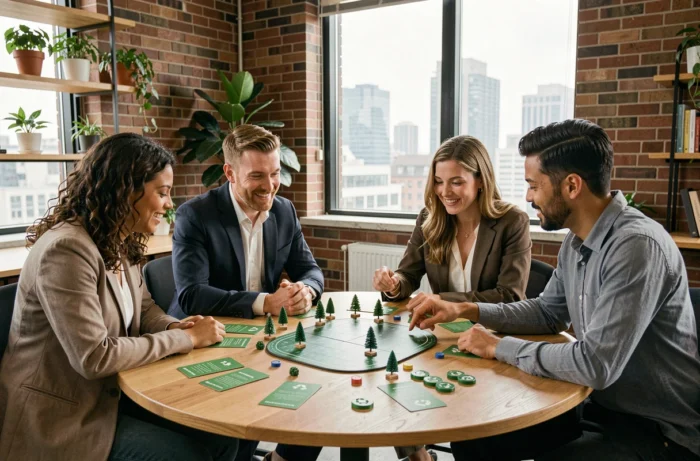
During a traditional seminar on sustainable development, half of the participants lose interest after twenty minutes. Presentations on carbon footprint or waste sorting end up looking the same. The serious game takes the opposite approach: it places each employee in front of concrete decisions, with visible consequences on the screen or on the board.
Ecology serious game: what changes compared to a traditional workshop
A traditional awareness workshop relies on the transmission of information. The trainer speaks, the teams listen, and then a quiz validates understanding. The serious game reverses this logic. Participants act first, observe the effects of their choices, and then draw their own conclusions.
This experiential learning mechanism produces a result that PowerPoint presentations struggle to achieve: a lasting change in behavior, not just an awareness. Recent academic work shows that serious games focused on consumption choices can measurably reduce environmentally impactful practices, provided the game includes ongoing monitoring and feedback on observed results.
In other words, the game does not simply highlight a problem. It creates a decision-making experience. Should we invest in public transport or in energy renovation of buildings? Each decision alters a simulated ecosystem, and players see the consequences unfold before their eyes.
Several platforms offer formats tailored for businesses, such as the one available at https://ecosysgame.fr/, which showcases the management of an ecosystem and its biodiversity.
Game mechanics and engagement of CSR teams
You may have noticed that a board game captivates adults for hours, while a thirty-minute meeting induces yawns? The mechanism is the same in a serious game: the decision-consequence-adjustment loop continuously engages attention.
What makes a serious game effective for awareness
Not all serious games are created equal. A poorly designed game provides entertainment without learning. For an ecological serious game to work in a company, three elements must coexist.
- Realistic dilemmas related to the company’s activity: choosing between immediate profitability and sustainable investment, allocating limited resources, managing climate-related surprises. The closer the scenario resembles daily professional life, the more natural the transfer to reality.
- A visible feedback mechanism: participants must observe the impact of each decision on concrete indicators (biodiversity, emissions, water consumption). Without this feedback, the game loses its educational dimension.
- A structured debriefing time after the game: this is when players articulate what they have understood and identify parallels with their work environment. Without debriefing, the game remains mere entertainment.
Cooperation rather than competition
Cooperative formats yield better results in terms of environmental awareness. Players share a common goal (preserving an ecosystem, maintaining a carbon budget), which replicates the collective dynamic of ecological transition. Individual competition, on the other hand, encourages optimizing one’s own score at the expense of the common good, a counterproductive reflex when trying to teach sobriety.
Consultation and feedback: an underutilized use of serious games
Most companies use serious games as a top-down tool: a message is transmitted, and its reception is checked. A more recent use deserves attention.
The GREAT project, an international research program, integrated mini-climate questionnaires into popular mobile video games. The result: over 1.2 million complete responses collected from around 130 million players. Researchers demonstrated that games provide a reliable channel for conveying participants’ perceptions and preferences to decision-makers.
Transposed to the scale of a company, this principle opens a concrete avenue. A serious game can be used to gather employees’ ideas on environmental issues specific to their profession. Rather than filling out a form, teams express their priorities through their game choices. Management retrieves actionable data on the barriers and levers perceived by the field.

Choosing a serious game suitable for your company
The market for serious games in ecology has expanded. There are collaborative board workshops, digital simulations, and hybrid formats that combine the two. The choice depends on three practical criteria.
The first is the size of the group. A board game is suitable for sessions of five to ten people. To reach several dozen employees simultaneously, a digital format is more appropriate.
The second criterion is the link between the game’s scenario and the sector of activity. A game about forest management will resonate more with an agri-food sector than with an accounting firm. Some publishers offer customizable scenarios that incorporate the company’s real data (energy consumption, business travel, waste management).
The third point, often overlooked, concerns the post-game. An isolated serious game produces a spike in motivation that fades within a few weeks. To anchor changes, a follow-up plan must be established: regular reminders, shared indicators, monthly collective challenges. The game then becomes the starting point of a sustainable development approach, not its conclusion.
Ecology in the workplace suffers from a paradox: everyone agrees on the urgency, but traditional training struggles to translate this awareness into concrete actions. The serious game does not solve everything, but it fills a gap that traditional materials leave wide open, that of lived experience and collectively assumed decision-making.