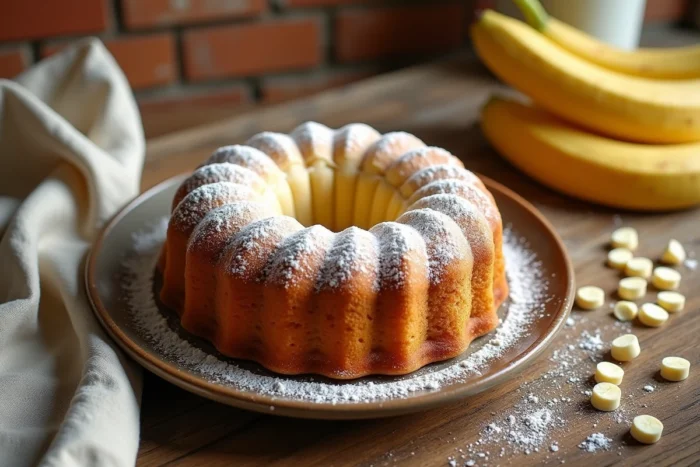
When you open the oven and the cake has risen unevenly, or the white chocolate has pooled at the bottom of the mold in a greasy puddle, you know something has gone wrong in the method. The banana and white chocolate cake seems simple on paper, but it’s a cake that doesn’t forgive sloppiness on two points: the ripeness of the bananas and the way the white chocolate is incorporated.
White chocolate in a banana cake: why it goes wrong
White chocolate melts at a lower temperature than dark chocolate. If you mix it directly into a warm batter or melt it too quickly, it separates: cocoa butter on one side, sugar on the other. The result is oily streaks in the crumb instead of melting pockets.
The method that works: cut the white chocolate into irregular pieces and incorporate them dry into the batter, like chocolate chips. Aim for cubes about one centimeter. In the oven, they soften without completely liquefying, creating those creamy areas in every bite.
If you want to melt the white chocolate (for a more homogeneous cake), do it in a double boiler without exceeding a gentle heat, then let it cool down before adding it to the batter. You can find a delicious recipe on Chapeau Melon that details this approach with a banana-white chocolate cake.
The other common pitfall: the quantity. Too much white chocolate weighs down the batter and makes it cloying. A ratio of about one-third the weight of flour in white chocolate provides a sweet-creamy balance without overwhelming the palate.
Overripe or underripe bananas: the slider that changes the texture of the cake
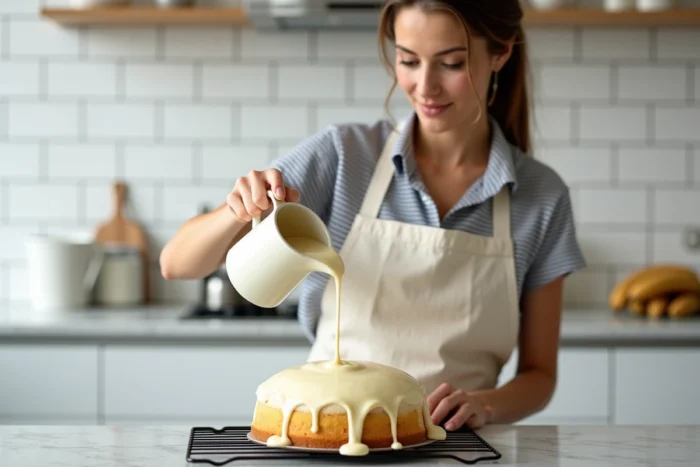
Everywhere you read that you need very ripe bananas. That’s true, but “very ripe” doesn’t mean the same thing in every recipe. For a banana cake, you want bananas whose skin is largely speckled with brown, almost black in places. The flesh should mash easily with a fork.
A still-yellow banana lacks natural sugar and moisture. The cake will be drier, denser, and the banana flavor will remain subtle. Conversely, a completely liquefied banana adds too much water, which can prevent the batter from rising properly.
Mashing the bananas with a fork rather than a blender makes a real difference. The blender turns the flesh into a smooth puree that incorporates too easily into the flour, leading to overworking the batter. With a fork, you keep small pieces that melt during baking and create an irregular crumb, exactly what you want from a cake.
No mixer, just one bowl
The trend of “no mixer, one bowl” has the merit of limiting the mechanical work of the batter. The more you mix, the more you activate the gluten in the flour, and the denser the cake becomes. Mix the dry ingredients on one side, the wet on the other, then combine the two with a few strokes of a spatula. The batter should remain slightly lumpy, which is normal and desirable.
Banana white chocolate cake: the baking that preserves the melt-in-your-mouth quality
A cake is not a loaf. You’re not looking for a uniformly golden crust or a tight crumb. You want a center that is barely set, almost quivering when it comes out of the oven, because the banana will continue to cook from thermal inertia as it cools.
- Preheating the oven with convection rather than static heat distributes the cooking better and prevents the top from burning while the center remains raw.
- Placing the mold in the lower third of the oven encourages cooking from the bottom, helping the batter to rise before the surface crusts.
- Check the doneness with a knife blade: it should come out with a few moist crumbs stuck to it, not dry or overly wet.
Feedback varies on the exact cooking time, as every oven has its quirks. Start checking early, then extend in increments of a few minutes if the blade comes out too wet.
Butter, oil, or yogurt: adapting fats to the desired result
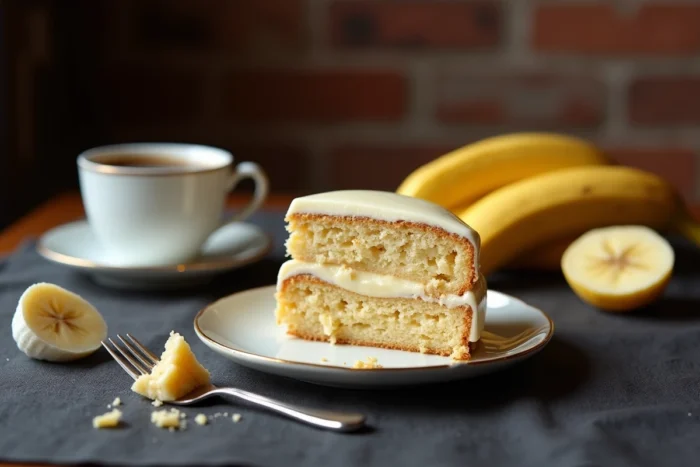
Butter adds flavor and a crumb that holds together. Vegetable oil (sunflower, canola) produces a moister, lighter cake in the mouth, but with less flavor. Yogurt, used alone or in combination, adds acidity that enhances the sweetness of the banana and white chocolate.
For a banana cake that stays tender for several days, replacing half the butter with plain yogurt works well. You lose a bit of richness, but gain in shelf life without the cake drying out.
Regular or whole wheat flour
Wheat flour T55 remains the most reliable choice for an airy cake. Whole wheat flour (T110 or T150) absorbs more moisture and gives a denser, more rustic crumb. If you want to use it, you can cut it half and half with T55 to maintain lightness while adding a nutty note that pairs well with banana.
- Flour T55 alone: light crumb, neutral taste, white chocolate and banana dominate.
- Half T55, half whole: denser crumb, nutty flavor, good hold when sliced.
- Whole flour alone: compact texture, to be reserved for those who like dense and filling cakes.
Sifting the flour is not a cosmetic gesture: it breaks up lumps and incorporates air, which lightens the batter even before baking.
The banana-white chocolate cake keeps under a clean cloth at room temperature. In the refrigerator, the crumb hardens quickly due to the starch recrystallizing. If you need to keep it for more than two days, it’s better to slice it and freeze it, then thaw the pieces individually at room temperature.