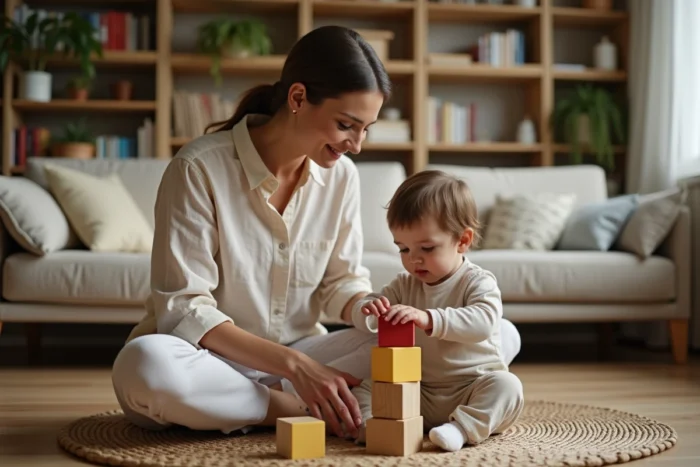
The development of a child relies on a set of skills that are built through ordinary daily situations. Language, emotional management, the ability to wait or cooperate: these achievements depend less on formal educational activities than on the quality of repeated interactions with close surroundings. Supporting this development means first understanding the mechanisms at play to adjust one’s parenting approach.
Executive Functions: The Invisible Foundation of Child Development
Before discussing autonomy or behavior, one concept deserves to be established. Executive functions encompass the ability to concentrate, inhibit an impulsive response, and adjust behavior in the face of a new situation. A report from INSERM published in 2023 shows that these skills are primarily developed through small daily experiences: simple rule games, adapted household chores, and micro-physical challenges.
The child’s participation in family life is a central lever. Setting the table, sorting socks by pair, watering a plant: these mundane actions engage working memory, planning, and patience. Structured “educational” activities (workbooks, apps) lag far behind in terms of impact on these functions.
Specifically, a child who helps prepare a cake learns to follow steps in order, to wait for the timer to ring, and to manage the frustration of not licking the bowl right away. It is precisely this type of situation that trains the brain to regulate impulsivity and maintain attention. To explore further the stages of development according to each age group, you can access the child section of Parenting Advice.
Parent-Child Interactions and Language Development
Language does not develop through passive exposure. A child watching a screen alone hears words but cannot use them. According to a meta-analysis published in 2022 in the journal JAMA Pediatrics, screen use before age 3 is associated with language delays and a decrease in parent-child interactions.
The French Society of Pediatrics recommends an active presence of the parent when the screen is used rather than a simple prohibition. Commenting on what is happening on screen, asking questions, rephrasing: it is the verbal exchange around the content that produces a positive effect, not the content itself.
Outside of screens, three practices effectively nurture language on a daily basis:
- Describing aloud what you are doing during routines (getting dressed, shopping, cooking), naming objects and actions precisely
- Allowing a moment of silence after asking a question to the child, to enable them to formulate their response without being rushed
- Rephrasing and enriching their sentences rather than correcting: if they say “cat gone,” respond “yes, the cat has gone into the garden”
This enriched rephrasing technique works because it validates the child’s attempt while offering them a more complete syntactic model. The child’s pace guides the exchange.
Emotions and Soothing Rituals in Daily Life
Research from INSERM and the OECD published between 2021 and 2023 documents a significant increase in anxiety disorders and depressive symptoms among children and pre-teens. In light of this finding, professionals emphasize the protective role of soothing micro-rituals in daily life.
Free playtime, evening reading, regular physical contact (morning hugs, a hand on the shoulder while talking) serve as emotional anchors. Their regularity matters more than their duration. A five-minute ritual every evening has more impact than an exceptional outing on the weekend.
Naming Emotions to Understand Them Better
A child is not born knowing how to identify what they feel. Anger, frustration, sadness first manifest through the body (screaming, crying, muscle tension). The parent’s role is to put words to these manifestations: “You are clenching your fists; you are angry because your brother took your toy.”
This verbalization does not eliminate the emotion. It allows the child to gradually build an emotional vocabulary that will become a tool for self-regulation. Over time, they will be able to say “I am frustrated” instead of hitting.

Adapted Environment and Child’s Self-Confidence
The arrangement of space directly influences the child’s level of autonomy. An environment where everything is out of reach fosters dependence. An environment where everything is accessible without limits creates chaos. The challenge is to provide a structured framework with limited choices.
Offering two outfits in the morning rather than an open closet. Placing toys at child height, but in reduced quantity. Installing a stable step stool near the sink. These concrete adjustments reduce conflicts related to refusals and frustrations because the child has real room to maneuver within a defined perimeter.
The Right to Make Mistakes as a Learning Driver
A glass of water spilled by a three-year-old serving themselves is not a failure. It is a learning step in motor coordination. Reacting with silent assistance (handing the sponge, demonstrating the action) rather than a negative comment preserves the momentum of autonomy.
Self-confidence is not built through generic compliments (“well done, that’s good”). It is built when the child realizes for themselves that they have achieved something concrete or overcome a difficulty with appropriate support.
- Valuing effort rather than results: “You tried several times before successfully buttoning your shirt; that’s what matters”
- Describing what you observe instead of evaluating: “You put all the blocks in the box” rather than “that’s beautiful”
- Accepting an imperfect result without taking over the task behind the child, so that their contribution retains its value in their eyes
Supporting development on a daily basis relies neither on complex methods nor on specialized materials. The most effective gestures are often the most discreet: a silence that allows time to respond, a ritual maintained even on difficult days, an environment that says “you can try” without the parent needing to articulate it.