Protecting your home against burglaries does not rely on a single miracle device. The most effective approaches combine multiple layers of protection, from physical barriers to electronic equipment, along with often overlooked daily habits. This article compares the different layers of security and identifies those that truly make a difference.
Tools and everyday objects: the forgotten security flaw
The official document from the Ministry of the Interior (My Security) highlights an angle rarely addressed by traditional guides: accessible DIY tools facilitate break-ins. Ladders leaning against a wall, screwdrivers or hammers stored in an unlocked garden shed, these items become instruments of intrusion for an opportunistic burglar.
Systematically storing these tools under lock and key, in a closed room or a padlocked garden shed, eliminates a concrete opportunity. This reflex costs nothing and complements any alarm system.
To identify the appropriate equipment for each access point of your home, Protect Habitation’s home selection groups devices categorized by type of protection.
Layered security: comparison of passive and active protections
The latest specialized content converges towards a logic of layered security rather than a single device. The principle: each layer slows down or deters, and it is their cumulative effect that makes the break-in too long or too risky for the burglar.
| Type of protection | Examples | Main function | Limit if used alone |
|---|---|---|---|
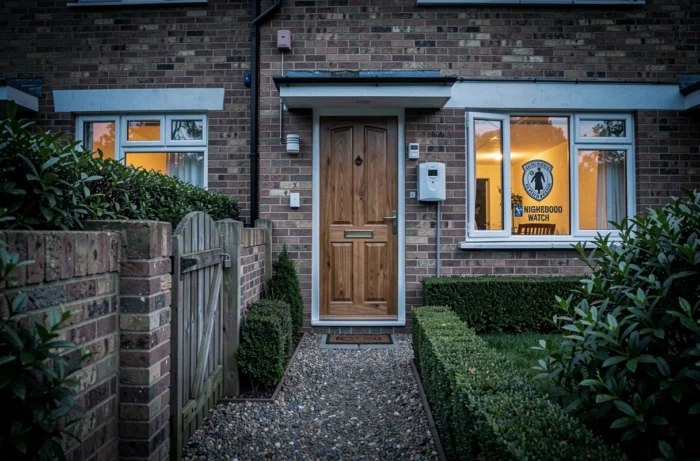
| Visual deterrence | Programmed outdoor lighting, motion detectors | Indicate an occupied or monitored home | Does not block a determined attempt |
| Physical barrier | Reinforced door, high-security lock, sturdy shutters, grilles | Delay or prevent access | Ineffective if left open or poorly installed |
| Electronic detection | Alarm, surveillance camera, opening detectors | Alert in real-time (owner or company) | Intervenes after the intrusion has begun |
| Daily habits | Double-locking, not announcing absences online | Eliminate opportunity signals | None if combined with other layers |
The “limit” column shows why an alarm alone or a reinforced door alone is not enough. It is the combination of at least three layers that significantly reduces risk.
Doors, windows, and shutters: prioritizing vulnerable access points
Competitors often treat doors and windows interchangeably. In practice, the hierarchy of risks varies depending on the layout of the home.
Entry doors and locks
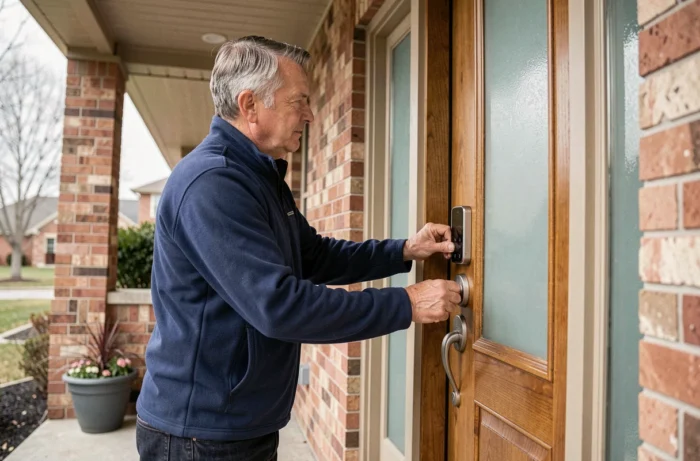
A reinforced door equipped with a multi-point lock remains the most deterrent physical barrier for the main access. The often overlooked point: double-lock even when at home, as recommended by the government document. Leaving the key in the interior lock at night is a common reflex that, paradoxically, can facilitate opening from the outside on certain cylinder models.
Windows and glass doors
Windows accessible from the ground floor, a balcony, or an adjacent flat roof are prime targets. Installing rolling or hinged shutters with an interior lock, or even grilles on the most exposed openings, adds a physical barrier that a simple glass pane does not provide.
Secondary access
Garage door, basement door, garden access: these entries are often less protected than the main door. Ensuring they have locks of equivalent strength prevents creating a weak link in the overall system.
Alarm, camera, and detectors: what really matters in an electronic system
The market offers wired and wireless alarm systems, with or without monitoring subscriptions. Rather than ranking products, here are the technical criteria that separate a truly useful system from a gadget.
- Opening detectors on every access point: a system that only covers the front door leaves all windows unmonitored. Every vulnerable opening must be equipped.
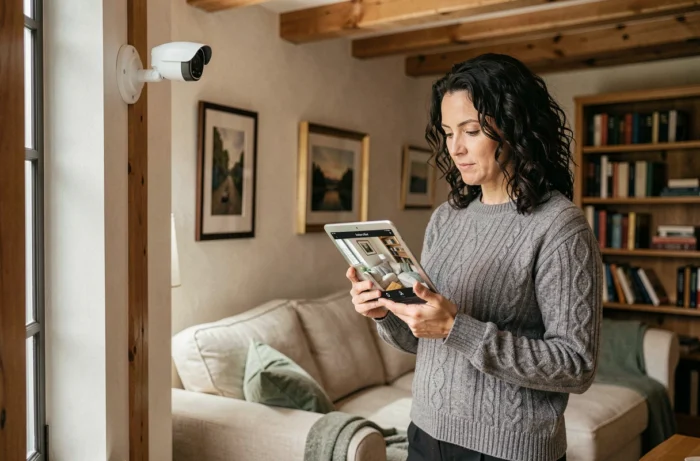
- Surveillance camera with night vision and secure storage: a camera whose feed is only local loses all utility if the burglar takes the unit. Remote storage (cloud or dedicated server) retains usable images.
- Outdoor siren coupled with smartphone notification: the siren draws the attention of the neighborhood, the notification allows for remote response or alerting law enforcement.
- Monitoring contract with verification: some plans provide for an operator to verify the alert before sending an intervention, which reduces false alarms while ensuring a quick response.
A complete system loses its effectiveness if it is poorly configured or habitually disabled. The regularity of use is as important as the quality of the equipment.
Digital protection and absence signals: mistakes that attract burglars
Posting your vacation dates on social media, leaving a detailed out-of-office message on your voicemail or professional email: these habits signal an empty home to anyone looking for a target. The official recommendation from the Ministry of the Interior is explicit on this point.
Programming variable indoor lighting (not just a continuously lit lamp, which quickly becomes suspicious) and asking a neighbor to collect the mail remain simple yet measurable gestures in terms of deterrence. A home that appears inhabited discourages the majority of opportunistic attempts.
The strength of residential protection is measured by its weakest link. An unlocked shutter, an accessible tool in the garden, or a careless post on social media can negate the effect of a high-performing alarm system. Checking each layer, from the lock to digital habits, remains the most reliable method to concretely reduce the risk of burglary.