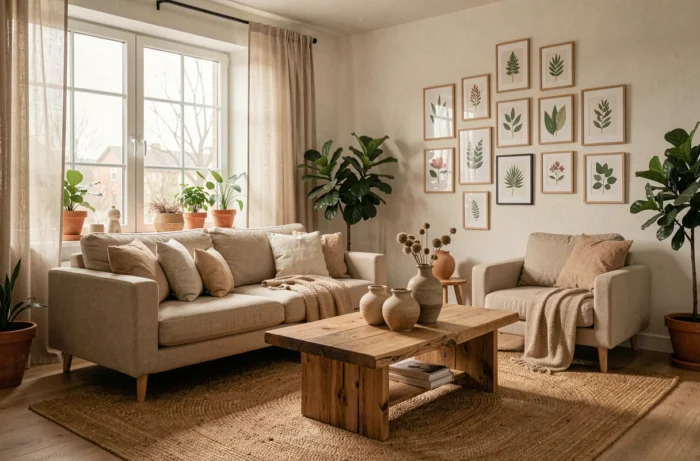
The palettes offered by paint manufacturers and furniture makers converge on a common axis: saturated shades applied in color drenching (walls, baseboards, woodwork, ceiling in the same tone) and raw materials left visible. Understanding the technical mechanisms behind these trends allows for making trendy home decor choices that endure over time, without the fleeting effects of fashion.
Color drenching and surface treatment: the technique behind the decor trend
Color drenching is not about painting an accent wall. We are talking about total chromatic immersion where the same paint reference covers all surfaces in a room, including woodwork and radiators. The result erases visual breaks between planes and perceptually enlarges the space.
For the effect to work, the choice of finish type per surface becomes crucial. A wall in deep matte (velvet or extra-matte) absorbs light, while woodwork treated in satin or semi-gloss creates a slight texture contrast without breaking the color unity. On a low ceiling, we recommend a fully matte finish to avoid reflections that compress the volume.
The most commonly used shades in 2026 revolve around wine-red and warm browns like Mocha Mousse. These dense pigments require a minimum of two coats over an opaque primer; otherwise, the underlying surface shows through in patches. Several leading brands in interior decoration now offer ranges dedicated to this type of monochrome application, with technical sheets specifying compatibility between finishes. Various selections are available on https://www.maisonartdeco.fr/ to identify suitable color and material combinations for this type of project.
Furniture with organic lines: manufacturing constraints and material choices
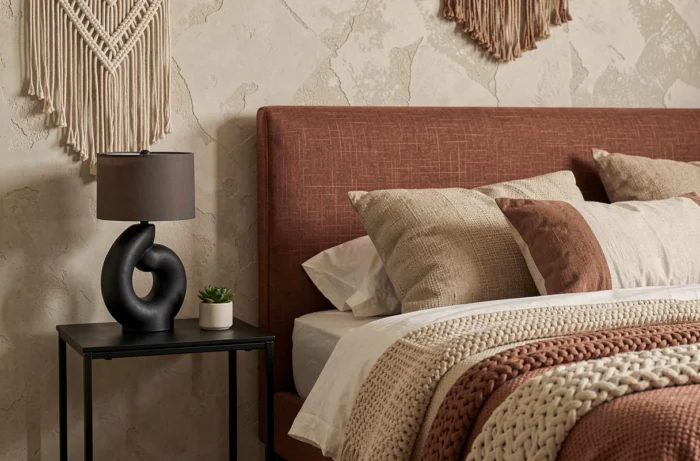
The curved shapes dominating trendy furniture are not merely an aesthetic whim. They reflect an evolution in the bending processes of solid wood and the molding of bio-sourced resins, making these shapes accessible in semi-industrial production.
Walnut and steamed ash bend better than oak, whose straight grain resists tight curves. This is why seating and consoles with pronounced curves favor these species. Checking the wood’s origin and the bending process (steam or laminated) provides a reliable indication of the piece’s longevity: steam bending on solid wood retains its shape much longer than low-quality laminated wood.
For seating, high-resilience foams covered with boucle or corduroy fabrics enhance the organic aspect. We observe that dense boucle coverings offer significantly better resistance to pilling than loose loops, a criterion rarely mentioned in consumer product sheets.
Textures and cozy minimalism style: moving beyond decorative accumulation
The Grandmillennial style and cozy minimalism share a common foundation: layering textures rather than accumulating objects. Market analysis reports on decor in 2026 confirm a strong increase in sales of scalloped decor, ribbed vases, and highly textured throws, driven by a demand for emotional comfort.
The difference between a successful room and an overloaded interior lies in the hierarchy of textures. We apply a simple rule:
- A dominant texture that covers the largest visible surface (washed linen on a sofa, lime plaster on the walls)
- A secondary texture in counterpoint (woven rattan on a light fixture, matte ceramic on a coffee table)
- A punctual tactile accent (merino wool throw, ribbed velvet cushion) that attracts the hand without overwhelming the eye
This hierarchy avoids the trap of “too cozy,” where every surface competes in thickness. A textured interior remains readable when a single material visually dominates.
Personalization through AI: what tools are changing in interior decoration
Generative AI tools applied to interior design have surpassed the gadget stage. In 2026, several platforms allow you to simulate a complete color drenching palette on a photo of your room, test the placement of furniture to actual dimensions, and visualize the light rendering based on window orientation.
The technical contribution mainly lies in optimizing layouts. An algorithm calculates the minimum circulation between furniture, identifies dead zones, and proposes configurations that the human eye does not spontaneously consider. For an atypical-shaped living room (L-shaped, through, under the eaves), AI simulation significantly reduces proportion errors before any purchase.
The limitation remains the calibration of colors on screen. No digital rendering can replace a physical sample placed against the wall in natural morning and evening light. We recommend using AI to narrow down options, then systematically validate with paint test patches of at least 50 cm on each side.
Wall coverings and technical wallpaper: sustainable selection criteria
Wallpaper is making a strong comeback, but current products have little in common with the vinyl rolls of decades past. Non-woven references with acrylic coating resist moisture, are applied with wall glue (not paste-the-strip), and can be removed dry without damaging the substrate.
- For a humid room (bathroom, kitchen), prefer washable wallpaper with a sufficiently dense weight to avoid blisters
- For a living room or bedroom, standard non-woven is sufficient, provided the wall is prepared with a fine smoothing compound
- Block-print patterns and scalloped decor, typical of the Grandmillennial trend, should preferably be applied to a single wall to avoid visual saturation in rooms smaller than 15 m²
The choice of pattern conditions the perception of volumes. A vertical pattern elongates a low ceiling, while a horizontal pattern widens a narrow hallway. This simple rule remains the most effective decor lever to transform a room without altering the structure.
Trendy home decor in 2026 relies less on standout objects and more on coherent technical choices: a bold color palette, hierarchical textures, materials whose behavior over time is understood. It is this reading through material, rather than image, that distinguishes a sustainable interior from a decor dated in two seasons.