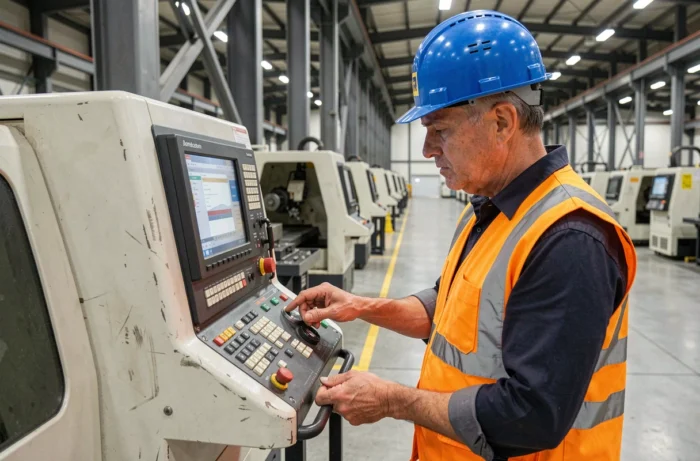
Undersized equipment doesn’t just slow down one workstation: it sets the pace for the entire line. Identifying which industrial machines deserve investment first means thinking in terms of bottlenecks, downtime costs and energy consumption—not browsing a generic catalog.
European machinery regulations are evolving, and new requirements—particularly for embedded software and cybersecurity—make it essential to factor regulatory compliance into the selection or retrofit process from the outset.
Production line bottlenecks: identifying the critical machine
Before buying or upgrading equipment, the first step is to map cycle times at each workstation. The slowest machine determines the throughput of the entire line. Investing in an upstream or downstream workstation without addressing this bottleneck will not produce any measurable increase in output.
Three criteria help rank equipment by criticality: mean time between failures, mean time to repair, and the impact of a stoppage on downstream workstations. A filler that stops for ten minutes can empty the buffer feeding a downstream cartoner and trigger a cascading shutdown. Choosing an industrial cartoner manufacturer for a production line whose equipment runs at a speed compatible with the upstream workstation helps prevent this kind of imbalance.
Digitalizing shop-floor data changes the picture. Vibration, temperature and current sensors installed on motors can detect deviations before they turn into breakdowns. The value of this approach depends on being able to trigger targeted maintenance—not simply storing charts on a server.
Industrial machine energy consumption: an underestimated operating cost
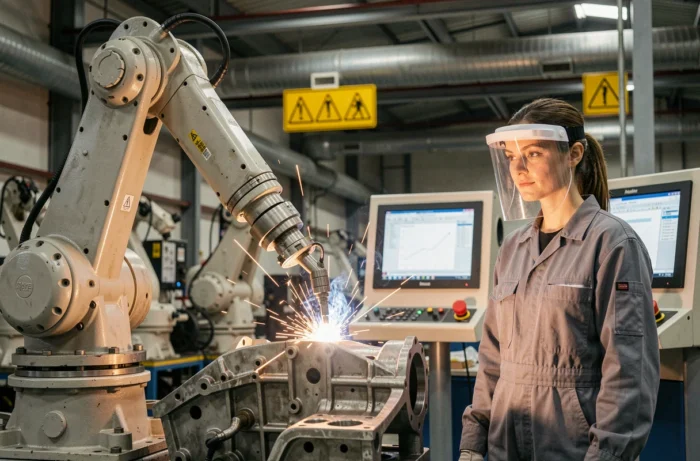
Energy has become an operating cost that needs to be managed just like raw materials. Focusing solely on production speed or overall equipment effectiveness overlooks a direct opportunity to improve profitability.
We find that the best-performing lines have energy meters for each machine, rather than just one per workshop. This level of detail makes it possible to compare an asset’s actual consumption with its rated consumption and detect deviations (worn bearings, a poorly configured variable-frequency drive, or a leaking pneumatic circuit).
The most energy-intensive equipment on a typical production line
On a packaging line, thermoforming and sealing stations account for most of the thermal energy consumption. Conveyors and material-handling systems, often overlooked, also use significant amounts of energy because they run continuously.
- Asynchronous motors without variable-frequency drives consume full power even at partial load. Replacing them with permanent-magnet motors can significantly reduce energy bills.
- Compressed-air systems commonly have leaks that account for a substantial share of total airflow. An annual audit is enough to locate them.
- Ovens and shrink tunnels often run at a constant temperature, even though batch-based controls could switch off the heating between production runs.
A targeted energy action plan covering just three machines can deliver a quick return on investment, provided consumption is measured before and after the work.
Predictive maintenance and regulatory compliance: preparing machinery for 2027
Predictive maintenance is no longer limited to automotive or pharmaceutical production lines. Affordable sensors combined with anomaly-detection algorithms now make it possible to equip packaging machines, presses and extruders without a major IT project.
The principle remains the same: prioritize equipment whose downtime costs the line the most. Installing sensors on a non-critical machine means collecting data that has no decision-making value. Targeting is key.
What the new European machinery regulations change
The gradual replacement of the Machinery Directive with a strengthened regulatory framework introduces specific requirements for embedded software and equipment cybersecurity. Any substantial modification to a machine (mechanical retrofit, addition of a programmable logic controller, or major software update) may mean that the company carrying it out is reclassified as a “manufacturer” for regulatory purposes, with the resulting CE compliance obligations.
A modernization project must therefore anticipate these new requirements. Three points deserve particular attention:
- Retrofit technical documentation must demonstrate that software safety functions can withstand intentional or accidental data corruption.
- Post-installation software updates must be tracked and validated through an updated risk assessment.
- The integration of connected sensors (for predictive maintenance or energy monitoring) falls within the scope if it changes the machine’s behavior or its safety functions.
Ignoring these regulatory changes risks a commissioning hold or a compliance recall, with financial and operational consequences far greater than the cost of a preliminary assessment.
Selecting production equipment: three questions to ask before investing
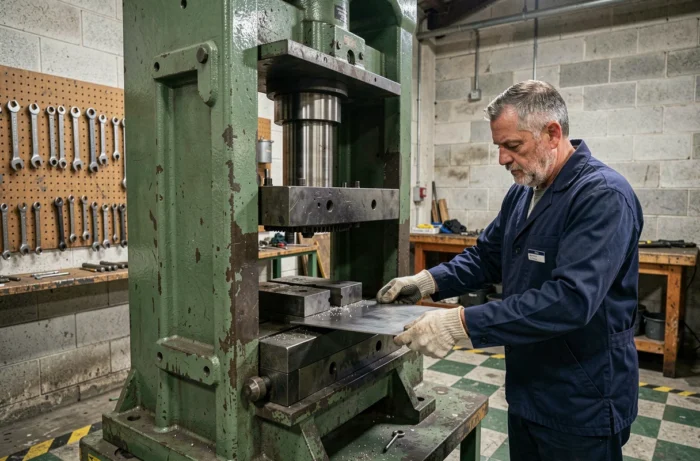
Rather than relying on a universal list of machines, the most reliable approach is to answer three questions for every proposed investment.
First question: Is this machine on the line’s bottleneck? If not, the investment will not increase overall throughput. It may be justified for other reasons (quality, safety or compliance), but not to improve production speed.
Second question: What is the total cost of one hour of downtime for this equipment? This includes lost production, restart time, scrap generated and the impact on downstream workstations. Equipment with the highest hourly downtime cost justifies investment in redundancy or predictive maintenance.
Third question: Does the supplier guarantee compliance with the European regulations in force when the equipment is commissioned? Equipment delivered in compliance with the current directive but not with upcoming requirements will need to be upgraded before entering production, delaying the schedule and increasing the budget.
Applying these three filters consistently helps avoid investments driven by the supplier’s catalog rather than the realities of the production line. A high-performing machine is of little value on its own if it does not address the constraint limiting production.