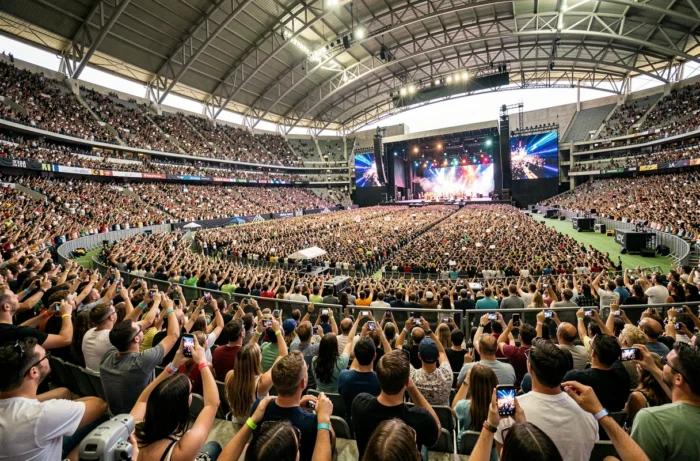
At the Stade de France, the advertised capacity for a concert is not the same as for a football or rugby match. The stage layout, its orientation and the seating arrangement (seated, standing, standing pit) redefine the number of seats and how they are divided into categories for each event. Understanding these factors before buying a ticket helps avoid unpleasant surprises on the day.
Why seating categories change from one concert to another at the Stade de France
A common instinct is to check a generic seating plan to find your seat. At the Stade de France, this approach doesn’t work. Categories are set by the event organiser, not by the stadium itself. From one concert to another, the number of categories, the areas they cover in the stands and the associated prices can all vary.
The stage position explains much of this variation. A front-facing stage set up at one end of the pitch leaves most of the stands in view but makes the seats directly behind it unusable. A central 360-degree stage opens up views from every section and increases the total capacity by tens of thousands of seats compared with a front-facing setup.
For the Rockin’1000 event, for example, the stage was positioned on the east side of the stadium, changing not only the distribution of categories but also the access routes: the hospitality suites were accessed via Gate T, an unusual route. A reference guide to Stade de France concert seating categories and capacity explains these differences between setups.

Stade de France capacity: front-facing stage vs. 360-degree stage
The stadium has 80,698 seats in its sports configuration. In concert mode, this figure varies depending on the stage setup chosen by the artist or promoter.
| Configuration | Approximate capacity | Areas included |
|---|---|---|
| Match (football, rugby) | Approximately 80,700 seats | All stands |
| Concert with front-facing stage | 55,000 to 60,000 seats | Stands with a view + pitch (standing pit, standing area) |
| Concert with 360° stage | Up to 90,000 – 100,000 seats | All stands + entire pitch |
The difference between a front-facing setup and a 360-degree setup can amount to 30,000 to 35,000 additional tickets. This difference affects more than just the number of seats: it also reshapes the hierarchy of seating categories.
With a front-facing stage, nearby side seats often offer better value for money than seats facing the stage in the upper stands. With a 360-degree setup, the distinction depends more on distance from the stage than on viewing angle.
Standing pit, pitch and stands: what each area means in practice
“Pitch” or “standing pit” tickets refer to standing areas set up on the field. When there is a pit, it is the area closest to the stage, usually separated by barriers. The rest of the field is converted into a standing area.
- The standing pit (also called “gold pit” or “gold square”, depending on the terminology) guarantees proximity to the stage but means waiting on your feet for several hours, with no seat and no guaranteed view for shorter spectators
- The standing area offers more room to move and a greater distance from the stage, which can improve the sound experience, but no assigned spot
- Lower side stands combine an unobstructed view of the stage with a numbered seat, making them a more comfortable option for concerts lasting over two hours
- The upper stands are the cheapest seats; the greater distance is offset by a panoramic view of the entire stage setup
Comfort and visibility depend as much on the area you choose as on the concert’s specific setup. Two “Category 2” tickets bought for different events may correspond to seats far apart from each other in the stadium.
Accessibility and specific provisions: details to check for each concert
Accessibility at the Stade de France is about more than just having seats reserved for people with reduced mobility. Official information for each event specifies the designated entrance, accessible shuttle services and available assistance.
Some concerts offer specific sensory options, such as areas adapted for spectators with sensory disorders. These provisions are not available at every event: their availability depends on the organiser and the date.
When audio description is available, you also need to book a ticket in an area compatible with the technical setup. Checking these details before buying, directly on the relevant event page on the Stade de France website, is the only reliable way to be sure.
Choosing your category at the Stade de France: what matters
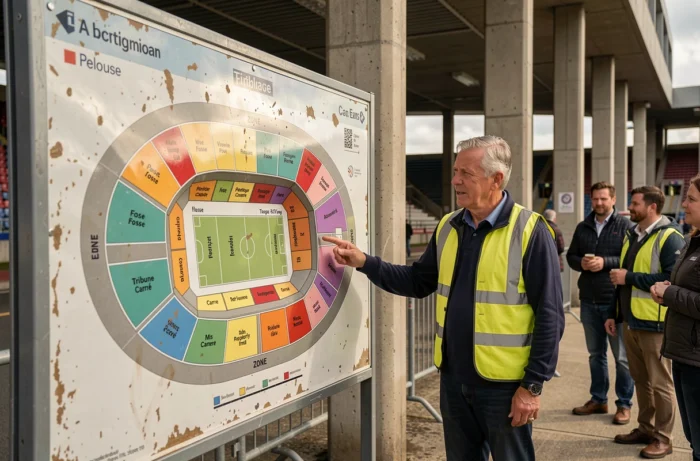
A generic stadium plan gives you an idea of the layout of the stands. It tells you nothing about the actual stage position, closed-off sections or access routes specific to a particular concert.
- Check the seating plan published for the specific event, not a generic stadium plan
- Find out whether the stage is front-facing or 360 degrees, as this affects the value of each category
- Check access arrangements (assigned entrance, opening times and any restrictions on certain sections)
The stage setup determines the true value of a ticket category. In terms of visibility, a Category 1 seat behind a front-facing stage is worth less than a well-positioned Category 2 seat on the side. Organisers adjust prices accordingly, but labels such as “gold”, “Category 1” and “pitch” are not standardised across promoters.
The Stade de France remains the largest concert venue in France, with a capacity that can exceed 90,000 spectators depending on the stage setup. This flexibility, which makes it ideal for hosting world tours, makes it all the more important to treat each concert as a unique event, with its own seating plan, categories and access requirements.