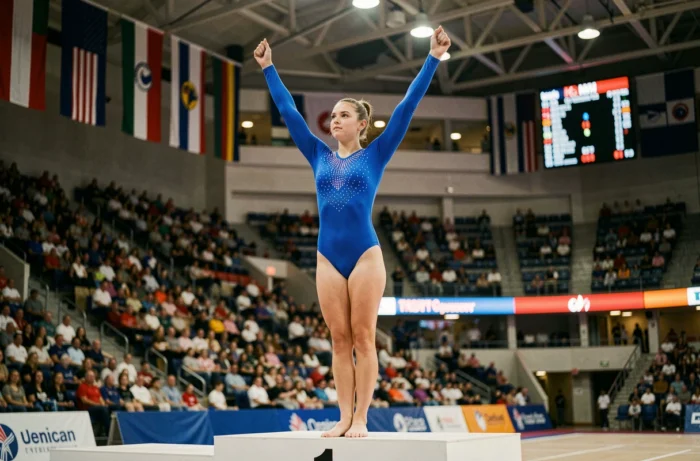
When watching a gymnastics competition for the first time, confusion sets in quickly: the same athletes perform on the same apparatus, but the medals awarded are not the same from one phase to another. Competitive gymnastics combines individual events and team events within the same championship, with separate rankings for each format.
Artistic Gymnastics: The Same Routine Fuels Two Rankings
In artistic gymnastics, during the qualifications, each gymnast performs their routines on the apparatus. These scores are used simultaneously to establish the team ranking and to qualify athletes for the individual finals (all-around and apparatus finals).
Thus, there is not a solo competition followed by a separate team competition. It is the same performance that is counted twice, in two different scoring grids. This peculiarity often surprises spectators accustomed to sports where individual and collective formats are entirely distinct events.
In the team phase, the scores of gymnasts from the same country are added together. Several federations then choose which scores to keep and which to discard, according to the rules in force. In the individual final, each athlete competes for their own account, with a medal for the all-around (sum of all apparatus) and medals for each apparatus.
The question of how gymnasts compete individually is detailed on enformechaquejour.fr for more information on the qualification and scoring mechanisms specific to each format.
FIG Scoring Code 2025-2028: What Changes in Solo and Team Strategy
The FIG regulations for 2025-2028, effective from April 1, 2025, have changed the way difficulty is counted. In men’s artistic gymnastics, the non-vault events have reduced from ten to eight counting elements in difficulty. In rhythmic gymnastics, the number of difficulties considered in senior individual events has also been reduced.
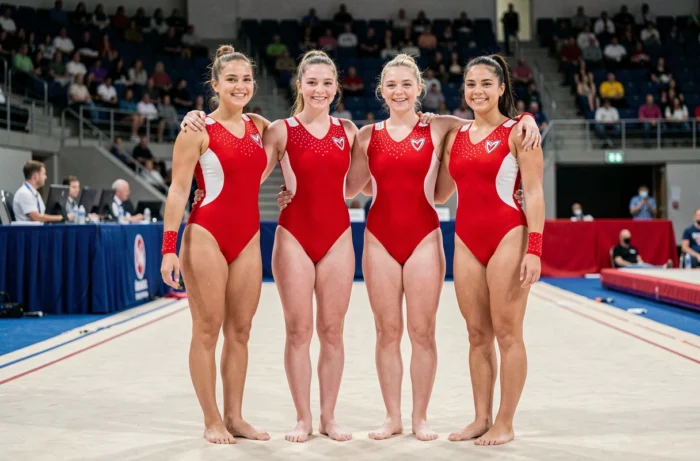
This change has a direct impact on the strategy of coaches, whether in individual or team format. With fewer elements counted, the quality of execution weighs more than the accumulation of skills. A gymnast who attempts too many difficulties without mastering them loses execution points, which also penalizes their team’s overall score.
In team competitions, this constraint forces selectors to rethink the composition of the group. They no longer necessarily seek the most acrobatic gymnast on each apparatus, but rather the one whose routine will be the cleanest, with the best difficulty/execution ratio.
Rhythmic Gymnastics: The Team Ranking is Not a Team Sport
Rhythmic gymnastics illustrates the blurry line between solo and team. The world team ranking is actually based on the sum of individual performances and a group routine (the group with five gymnasts and apparatus). It adds separate performances rather than functioning like a handball or football team.
In practice, a rhythmic gymnast can earn three types of medals at the same championship:
- A medal in the team ranking, calculated from the sum of the best individual scores and the group routine
- A medal in the individual all-around, based solely on their own performances on the different apparatus
- A medal in the apparatus final (hoop, ball, clubs, ribbon), where they compete alone against the other qualifiers
The term “team” thus encompasses very different realities depending on the discipline. In acrobatic gymnastics, duos or groups perform a coordinated routine together. In rhythmic gymnastics, the group routine is collective, but the team ranking also aggregates individual results. In artistic gymnastics, the team is never on the mat at the same time.
Apparatus and Competition Format: How the Solo or Team Choice is Made in Clubs
At the club level and in regional competitions, the distinction between solo and team arises as soon as registration begins. In women’s artistic gymnastics, gymnasts can compete in teams and individually, sometimes at the same event. The choice depends on the club’s roster, the level of the gymnasts, and the season’s goals.
Some clubs do not have enough gymnasts at the same level to form a complete team on all apparatus. In this case, athletes register only for individual competition. Conversely, a club with a large roster can field a team while allowing its top athletes to aim for individual finals as well.
The apparatus practiced varies by discipline:
- WAG (women’s artistic gymnastics): vault, uneven bars, balance beam, floor
- MAG (men’s artistic gymnastics): floor, pommel horse, rings, vault, parallel bars, high bar
- Individual rhythmic gymnastics: hoop, ball, clubs, ribbon
- Trampoline and tumbling: individual formats with specific difficulty and execution criteria
A high-level gymnast generally participates in both formats at the same championship. The question is therefore not “solo or team” as an exclusive choice, but rather a layering of rankings fed by the same routines or by specific events.

Apparatus Finals and All-Around: Where the Individual Title is Really Contested
The apparatus finals represent the most purely individual format of competitive gymnastics. Only the best qualifiers on each apparatus gain access, with a single performance determining the ranking. The all-around, on the other hand, requires complete versatility since the gymnast must perform on all apparatus in their discipline.
The all-around rewards consistency across all apparatus, while the apparatus finals value specialization. A gymnast may dominate on the rings without ever making it to the podium in the all-around, because their scores on floor or pommel horse penalize them.
This distinction explains why some athletes focus on one or two apparatus towards the end of their careers, forgoing the all-around to increase their chances in the apparatus finals. Feedback on this point varies among federations, with some still prioritizing versatility in their selection criteria.
Competitive gymnastics thus operates on a principle of nested drawers: the same championship awards team titles, an all-around title, and apparatus titles. Athletes compete both individually and as a team, often on the same day, on the same apparatus, with the same scores redistributed into parallel rankings.