
Crème fraîche and mascarpone often occupy the same shelf in the supermarket, but their behavior in the kitchen differs based on measurable criteria: fat content, cooking stability, caloric contribution, and ability to aerate. Comparing these two dairy products based on concrete data allows for quick decisions depending on the intended recipe.
Fat and calories: the comparative table of crème fraîche versus mascarpone
The first difference between these two products is evident on the nutritional label. Mascarpone has a significantly higher fat concentration than thick crème fraîche, which alters both the texture achieved and the energy contribution of the finished dish.
| Criterion | Thick crème fraîche (30% fat) | Mascarpone |
|---|---|---|
| Fat content | About 30% | Often between 60 and 75% |
| Consistency when cold | Semi-thick, slightly acidic | Dense, creamy, neutral to sweet taste |
| Origin | Fermented cream (France) | Cow’s milk cream coagulated with acid (Lombardy, Italy) |
| Whipping stability | Whips well in liquid form (liquid cream) | Does not whip alone, serves as a binding base |
| Acidity | Slight natural acidity (lactic fermentation) | Very low acidity |
What stands out from the comparison can be summed up in one sentence: mascarpone provides double the fat for a more neutral taste. Crème fraîche, with its acidity, alters the flavor balance of a sauce or mixture more significantly.
Several dietary websites now classify mascarpone among the ingredients to limit for weight control, in favor of whole crème fraîche or yogurt. Understanding the differences between crème fraîche vs mascarpone in cooking helps to measure the richness of a dish without sacrificing texture.
Cooking behavior: crème fraîche and mascarpone do not react the same
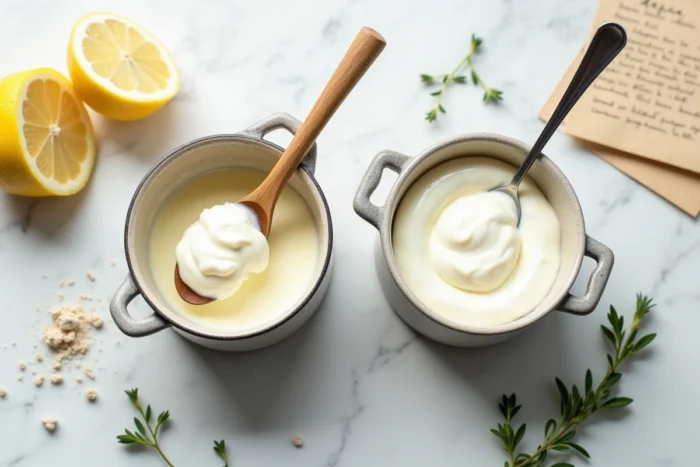
The difference in fat content has a direct consequence in cooking: heat stability. Thick crème fraîche holds up well during long cooking times in sauces, gratins, and stews. Its natural acidity also allows for deglazing a pan without the sauce curdling.
Mascarpone, on the other hand, performs better when cold or warm. When incorporated into a hot sauce, it melts quickly but tends to separate if the temperature rises too high. For pasta, it should be added off the heat, at the end of preparation, to maintain its creamy consistency.
Salty sauces and dishes: the right reflex
- For a gratin or quiche that goes in the oven, thick crème fraîche remains the most reliable choice: it coagulates without curdling and provides binding to the mixture.
- For a creamy pasta sauce served quickly (like a revamped carbonara), mascarpone gives a richer and silkier result, provided it is incorporated off the heat.
- To deglaze meat or pan-fried fish, liquid crème fraîche (liquid cream) is preferable: its acidity balances the cooking juices, where mascarpone would weigh down the dish.
The choice between the two products thus comes down to a question of temperature and cooking duration. The longer the dish cooks, the more justified crème fraîche becomes.
Desserts and homemade pastries: where mascarpone has the advantage
In pastry, the situation reverses. Mascarpone is an Italian fresh cheese designed for cold or lightly cooked preparations. Tiramisu is the most well-known example, but it also serves as a base for mousses, verrines, and no-bake cheesecakes.
Its dense texture allows for stabilizing a cream without the addition of gelatin, which crème fraîche does not do. Whipped alone, liquid crème fraîche produces an airy whipped cream, but it lacks stability over time. Mixed with eggs and sugar, mascarpone maintains its structure for several hours in the refrigerator.
Lightening a mascarpone dessert: the trend of mixing
Several pastry blogs are now testing combinations that reduce the richness of mascarpone while retaining its creaminess:
- Mascarpone and Greek yogurt in equal parts for a lighter tiramisu or verrines.
- Mascarpone and ricotta in a 50/50 ratio to maintain structure in a cheesecake while lowering the overall fat content.
- Mascarpone and fromage blanc for dessert creams where freshness is as important as richness.
Replacing half of the mascarpone with a lighter product decreases the caloric density of the dessert without radically altering the consistency. Classic whipped cream based on liquid crème fraîche remains the best option for airy decorations and fillings.

Substituting crème fraîche – mascarpone: when the swap works and when it fails
The question often arises: can one replace the other without altering the recipe? The answer depends on the type of dish.
In a hot sauce, replacing crème fraîche with mascarpone works as long as the heat is lowered and it is added at the end of cooking. The result will be richer and sweeter, with almost no acidity. In a gratin, the substitution is risky: mascarpone does not coagulate the same way and can make the surface oily.
In a cold dessert, replacing mascarpone with thick crème fraîche yields a less stable and more acidic result. A tiramisu made with crème fraîche will lack structure and roundness. Mascarpone has no direct equivalent for no-bake desserts.
For savory recipes where the cream mainly serves as a liquid binder (soups, light sauces, veloutés), crème fraîche remains irreplaceable. Its more fluid consistency incorporates better, and its slightly tangy taste enhances flavors without masking them.
Ultimately, the choice between crème fraîche and mascarpone hinges on three parameters: the temperature of the recipe, the desired fat level, and the expected stability of the final result. The two products are not interchangeable in all cases, and mixing them with yogurt, ricotta, or fromage blanc opens a third avenue to adjust texture and lightness according to the intended dish.