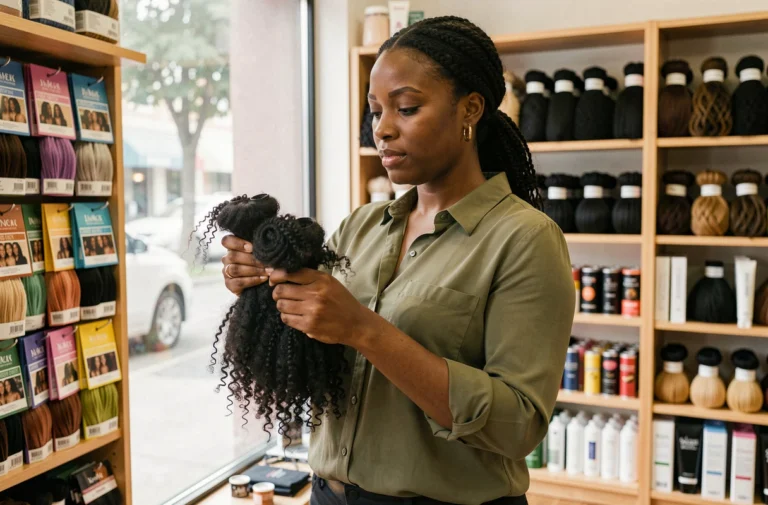
On short hair, braiding imposes technical constraints that length usually masks: tension on strands of a few centimeters, limited hold without suitable products, risk of breakage on textured hair. Mastering these parameters allows for the use of braid styles that work well on both a short bob and a long pixie cut.
Preparing short hair before braiding: products and texture
The success of a braid on short hair is determined before the first strand. Smooth hair freshly washed slips between the fingers and does not hold in a braid. We recommend working on slightly textured hair, ideally washed the day before.
For kinky, curly, or frizzy hair, specialized hairstylists now recommend alcohol-free styling creams low in silicones. This approach limits breakage during repeated braiding and reduces frizz without weighing down the fiber. Strong-hold gels should be avoided: they stiffen the strand and cause micro-breaks with each manipulation.
On fine and smooth hair, a sea salt texturizing spray or a volumizing powder applied at the roots provides enough grip for the strands to stay in place. Working section by section with crocodile clips facilitates control, especially when the available length does not exceed the jawline.
Adapting braided hairstyles for short hair to one’s hair texture remains the first technical step not to be overlooked.
Flat Dutch braid on short hair: technique and result
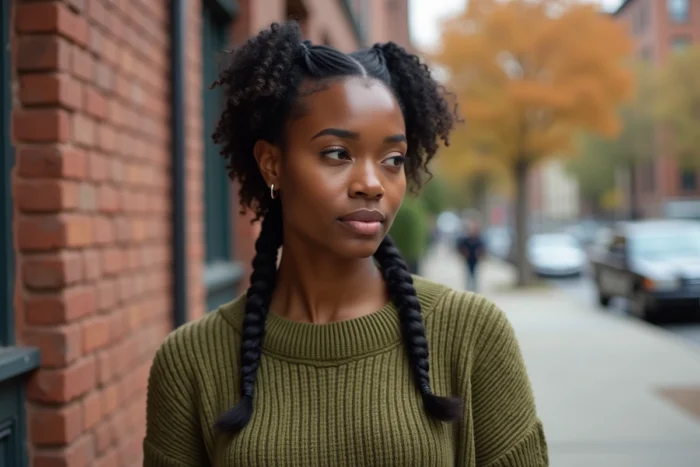
The Dutch braid differs from the French braid by passing the strands under the central strand, creating a visible relief on the surface. On short hair, this apparent volume visually compensates for the lack of length.
Starting as close to the hairline as possible with fine sections (about the width of a finger) ensures better anchoring. On a long pixie cut or a chin-length bob, we observe that a single side Dutch braid holds better than a central braid because the tension is distributed on one side instead of pulling back.
Asymmetrical variant for pixie cut
Flattening the braid on the longer side of a pixie cut creates a sharp contrast with the short side. The result resembles a braided undercut without needing to shave anything. Securing the end of the braid with invisible flat pins (crossed bobby pins in an X) prevents loosening on the last centimeters.
Hidden micro-braids: the trend that changes daily styling
Hidden micro-braids within short hair represent a growing trend. The principle: create two to four very fine braids, often behind the ear or along the part, then leave the rest of the volume free.
The effect achieved is an irregular texture that adds movement without the braided hairstyle being immediately identifiable. On short kinky hair, these micro-braids also serve as a structuring base for a twist-out the next day: braid in the evening, unravel in the morning, and the waves remain defined for several hours.
- Micro-braids behind the ears on a short bob: add volume at the back without accessories, hold all day with a simple setting mist.
- Micro-braids along the part on a long pixie: create a discreet graphic effect, particularly suited for a professional context.
- Partial crown micro-braids on short kinky hair: allow the forehead to be cleared while maintaining volume on top, without excessive tension on the temples.
Short cornrows and geometric patterns on afro cuts
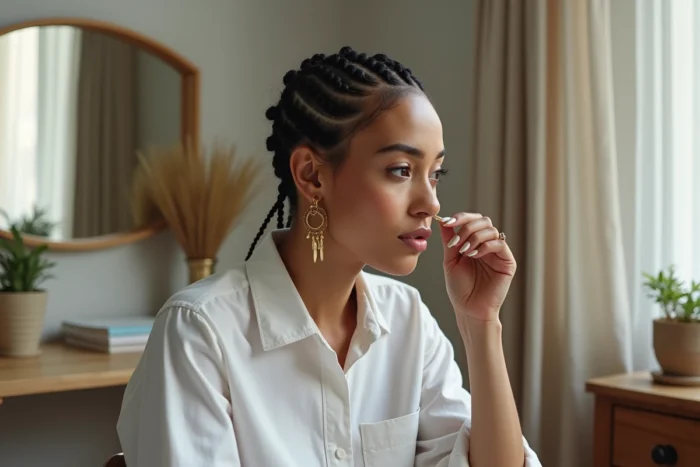
Cornrows remain the technical reference for short kinky hair. Contrary to popular belief, a length of a few centimeters is sufficient to create fine cornrows, provided that the tension is well calibrated to avoid weakening the hairline.
Geometric patterns (parallel lines, zigzags, spirals starting from the vertex) are a strong trend. The work is done with a tail comb, section by section, starting from the forehead to the nape or vice versa depending on the desired design.
Protecting the edges without sacrificing style
The most fragile area remains the frontal hairline and the temples. Avoid braiding too tightly on the first centimeters of the forehead prevents traction alopecia, a common issue when cornrows are repeated every two to three weeks. We recommend leaving baby hairs free or gently smoothing them with a soft brush and light gel rather than incorporating them into the braid.
Accessories and finishing touches to extend the hold of short braids
On long hair, the weight of the braid ensures part of the hold. On short hair, it is the accessories and finishing touches that do the work.
- Crossed flat pins in an X at each end of the braid: the most reliable method to secure strands of a few centimeters without a visible elastic.
- Transparent hair thread: wrapped around the tip of the braid, it prevents the last centimeters from unraveling, especially on smooth hair.
- Thin headband or satin scarf: used at night, it keeps the cornrows and micro-braids in place while limiting friction that causes frizz and breakage.
- Light alcohol-free setting mist: sprayed from a distance on the finished hairstyle, it adds hold for several hours without stiffening the hair.
A low braided bun works even on a short bob as long as the braids are gathered at the nape and secured with fan-shaped pins. The result is structured without requiring additional length.

Braids on short hair are not a downgraded version of long hairstyles. They require a different technical approach, focused on hair preparation, choosing the right type of braid suitable for the texture, and careful securing. It is better to master two or three styles that really hold than to multiply attempts on formats designed for other lengths.