The number of registered independent creators in France has significantly increased in recent years, driven by micro-enterprises and simplified access to online sales platforms. Behind this dynamic, the landscape of French craftsmanship is undergoing profound transformation. New statuses, digital tools, rethought qualifications: creators who are reinventing modern handmade do not just make; they are redefining the very conditions of their activity.
National Register of Enterprises and Handmade Craft: What Has Changed
As of January 1, 2023, the D1 extract issued by the Chambers of Trades and Crafts has been abolished. It is replaced by a National Register of Enterprises (RNE) extract, accessible online via the one-stop shop operated by INPI. This shift requires all artisans and micro-entrepreneurs to complete a fully digital registration process.
For creators who claim handmade, the consequence is direct: any buyer or partner can now verify an artisan’s legitimacy online, either by SIREN or by name. Transparency is increasing, but so is the administrative entry threshold.
A creator coming from informal self-production (local markets, sales on social media) must now formalize their status to remain visible and credible. Specialized platforms document this journey and gather verified profiles of French creators, as can be seen on https://made-by-createurs.fr/, which lists artisans active in various disciplines.
This digitization redraws the boundary between amateur creator, declared artisan, and independent brand. It favors those who master digital tools, but complicates the task for less connected artisans, often among the most experienced.
Recognition of Prior Learning: A Path for Self-Taught Creators
As of January 1, 2025, the reform of Recognition of Prior Learning (VAE) opens a simplified path for self-taught creators. The France VAE scheme allows for the recognition of skills acquired in the workshop, without having to go through a lengthy training program.
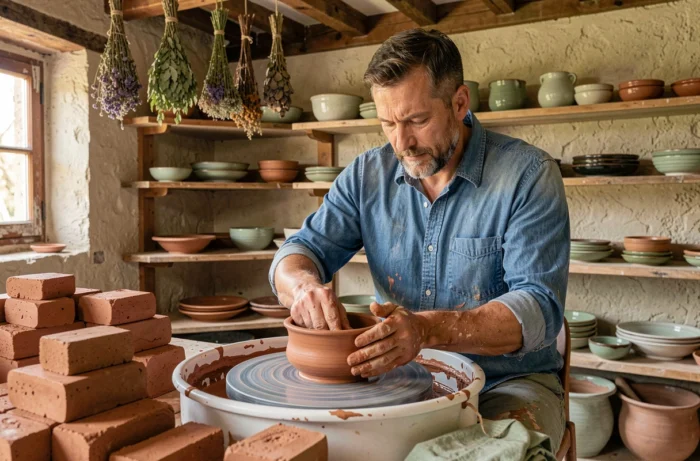
For a potter trained on the job or a seamstress who has been producing for years without a diploma, this reform changes the game. It allows for obtaining a recognized professional title based on actual experience, facilitating access to public markets, project calls, and quality labels.
At the same time, a new high school diploma, accessible directly after middle school, targets crafts such as cabinetmaking, watchmaking, or jewelry. This hybrid curriculum, halfway between technical training and workshop learning, reflects a desire to structure pathways without standardizing them.
Field feedback on this point varies. Some artisans see these measures as long-awaited recognition. Others fear a normalization that could erase the uniqueness of their approach.
Craftsmanship and Digital Tools: Between Traditional Workshop and Assisted Design
The image of the creator bent over their workbench does not disappear, but it is complemented by a new technical reality. Several trends are emerging in French workshops:
- 3D modeling allows jewelers, potters, and designers to test shapes before moving to manual production, reducing raw material waste.
- Laser cutting and 3D printing serve as complements to artisanal work for small series pieces, particularly in leather goods and textile design.
- Online management tools (invoicing, order tracking, customer relations) free up workshop time for creators who work alone.
The challenge is not to replace the gesture with the machine. Creators who succeed combine manual skills and digital tools without sacrificing the trace of the hand, that slight irregularity that an industrial mold never leaves.
The “Craftsmanship of Tomorrow” program, supported by organizations like the Chambers of Trades, accompanies this transition by offering digital diagnostics to artisans. The available data does not yet allow for measuring the real impact of these measures on the revenue of the workshops involved.

Artisanal Quality and Short Circuits: What Buyers Are Looking For
Buying from a French creator is primarily about purchasing traceability. The buyer knows who makes it, where, and often with what materials. This transparency, long reserved for food, is gaining ground in the arts and crafts sector.
Direct sales without intermediaries remain the dominant model among independent creators. Specialized portals, creator markets, and social media enable unfiltered contact between the artisan and their client. The price reflects the actual cost of labor, without distributor margins.
However, this direct relationship requires the creator to handle communication, logistics, and after-sales service alone. The time spent outside the workshop represents an increasing share of the activity, raising questions of sustainability for those who produce unique pieces with high added value.
Directories and portals dedicated to French creators attempt to address this issue by pooling visibility. Their effectiveness largely depends on their search engine optimization and the quality of their selection.
French Luxury and Arts and Crafts: A Blurred Boundary
Major luxury houses regularly recruit from independent workshops. Embroiderers, feather workers, lacquerers, mosaic artists: rare skills feed both the luxury market and the independent creation sector. The boundary between the two worlds is blurring.
For an artisan, working as a subcontractor for a luxury house guarantees stable income. But it reduces the time available to develop their own line. Some alternate between the two, while others choose total independence at the cost of greater precariousness.
This tension is not new, but it is intensifying as artisanal techniques gain media visibility. Exhibitions dedicated to arts and crafts are multiplying, and French artisanal design attracts an international clientele seeking the authenticity of the gesture as much as the finished object.
Modern handmade in France is not just a consumer trend. It is based on a rapidly changing ecosystem, where qualification, digital tools, and economic models matter as much as the talent of the craft. The creators who establish themselves sustainably are those who manage to articulate these dimensions without renouncing what makes their work unique.