
Childcare encompasses a much broader scope than just choosing a stroller or a bottle. Behind this term lies a set of practices, knowledge, and equipment related to the care and development of infants, from birth to the early years of life. Young parents are faced with a mass of information, sometimes contradictory, about their child’s nutrition, sleep, awakening, and health.
Environmental health of infants: a still unknown aspect
Recently, the French policy for the first 1000 days includes a pillar dedicated to the environmental health of babies and their parents. This aspect, which is structuring for the period 2025-2027, targets endocrine disruptors, indoor air quality, and household pollutants to which infants are exposed daily.
Specifically, official recommendations emphasize three simple actions: ventilate each living space at least once a day, favor household products with short ingredient lists (without synthetic fragrances or unnecessary antibacterial agents), and choose baby cosmetics with as few ingredients as possible. These recommendations apply from pregnancy onwards.
This environmental aspect changes the way childcare is approached. It is no longer just about feeding and putting a child to bed under good conditions, but about rethinking the material environment in which they grow. Parents looking for parenting information on Childcare Babies will find useful resources to delve into each of these aspects over the months.
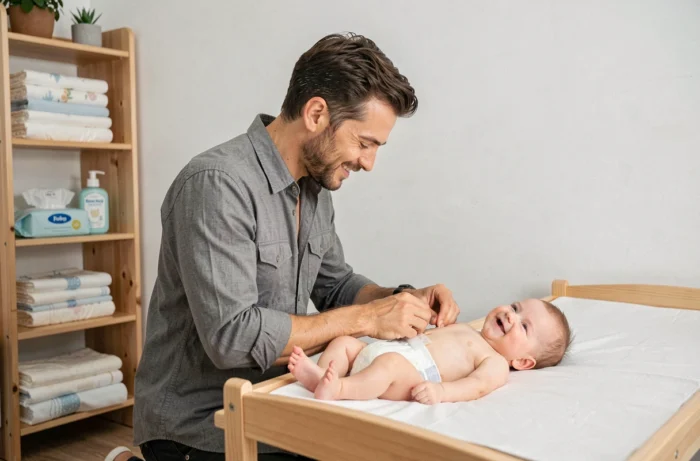
Baby nutrition and breastfeeding: updated guidelines
Nutrition remains the topic on which young parents ask the most questions. Breastfeeding, infant formula, complementary feeding: each family builds its own path, and there is no one-size-fits-all approach for all infants.
Breastfeeding or bottle feeding
The choice between breastfeeding and bottle feeding depends on the mother’s health, her professional constraints, and her personal comfort. Experiences vary on this point: some mothers view breastfeeding as a special moment, while others describe intense fatigue amplified by social pressure.
What matters is that the child receives nutritional intake appropriate for their age and weight, validated by a healthcare professional (pediatrician, midwife, or childcare professional in maternal and child protection).
Complementary feeding
Complementary feeding generally begins between four and six months, upon medical advice. Here are some concrete guidelines for this stage:
- Introduce only one new food at a time, over two or three consecutive days, to identify any potential allergic reactions.
- Start with cooked and pureed vegetables (carrot, zucchini, sweet potato) before introducing fruits, to acclimate the palate to non-sweet flavors.
- Avoid added salt and honey before one year, as honey may contain botulism spores that are dangerous for infants.
Infant sleep: sleeping arrangements and rhythms
Sleep is a significant source of parental anxiety. A newborn sleeps in short cycles, spread throughout the day and night. Sleep rhythms do not stabilize for several months, and variability from one child to another is considerable.
The sleeping arrangements, however, follow specific rules. The child sleeps on their back, in a firm crib without a pillow, duvet, or bumper. The room temperature ideally hovers around eighteen to twenty degrees.
A often overlooked point: the air quality in the baby’s room directly relates to the aforementioned environmental health aspect. A new mattress can release volatile organic compounds for several weeks. Allowing the mattress to air out in a ventilated room before first use reduces this exposure.

Parental mental health: a childcare issue in its own right
Perinatal mental health is now an integral part of the parenting journey in France. Since 2026, a strengthened pathway includes early detection of postpartum depression and parental burnout, with a dedicated interview systematically offered in postnatal follow-up.
This change reflects a documented reality: fatigue, isolation, and the mental load associated with infant care affect parents’ ability to meet their child’s needs. Parental well-being is not a secondary issue; it directly influences the quality of interactions with the baby during their first months of life.
The available data do not yet allow for precise measurement of the impact of this new system in practice. Feedback from maternal and child protection professionals will be crucial to assess whether early detection translates into effective support.
Awakening and development: stimulating without overstimulating
Infant awakening does not require a range of high-tech toys. In the first weeks, skin-to-skin contact, the parents’ voices, and simple visual contrasts are sufficient to nurture the child’s sensory development.
From three or four months, the child begins to grasp objects, follow movement with their gaze, and react to new sounds. A few principles guide the choice of awakening materials:
- Favor objects with varied textures (wood, fabric, natural rubber) rather than electronic toys with multiple stimuli.
- Limit time spent in containment equipment (bouncer, swing) to promote free movement on the floor.
- Screen time is still discouraged before two years, regardless of the content being shown.
The child’s rhythm takes precedence over any activity program. A tired baby or one in the process of falling asleep gains no benefit from a forced play session.
Childcare evolves at the same pace as knowledge in public health and child development. The guidelines of yesterday are not always those of today, especially regarding environmental health and parental mental health. Each family benefits from cross-referencing sources, relying on early childhood professionals, and adapting general recommendations to the reality of their daily lives.