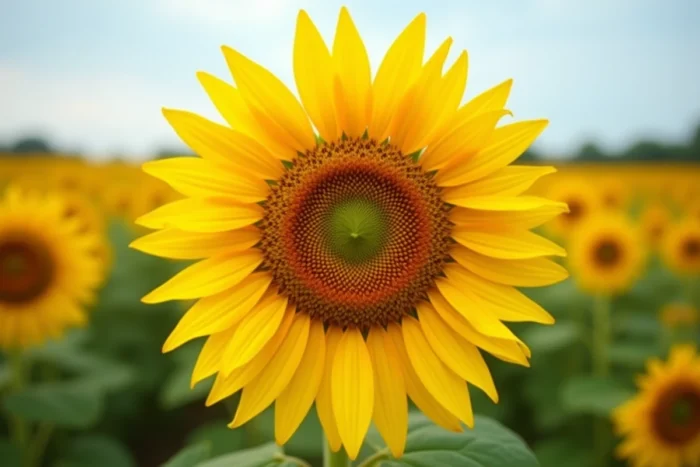
The sunflower has a scientific name that summarizes its nature: Helianthus, formed from the Greek helios (sun) and anthos (flower). This etymology anchors the plant in a solar symbolic register that transcends the ages. Understanding the meaning of the sunflower flower requires going beyond the decorative aspect to examine its symbolic, political, and social uses, which are far more varied than what traditional flower language suggests.
Sunflower Heliotropism: What Botany Really Says
Young sunflowers do indeed follow the sun’s path from east to west, a phenomenon called heliotropism. This movement is caused by differential growth of the stem: the shaded side elongates faster than the exposed side, which tilts the flower towards the light.
This mechanism ceases at maturity. Once flowering is achieved, most flower heads freeze facing east. This morning orientation promotes rapid warming of the flower, which attracts more pollinating insects in the early hours of the day.

The symbolism of fidelity and constancy often associated with the sunflower comes directly from this botanical observation. The flower does not “choose” the sun out of devotion, but the metaphor has transcended centuries, from Greek mythology (the myth of Clytie, a nymph transformed into a flower turned towards Apollo) to contemporary bouquets offered to express admiration. To delve deeper into the meaning of the sunflower flower, one must also consider its political and social dimensions.
Ecologist and Political Symbol: The Sunflower Beyond the Bouquet
The sunflower serves as an emblem for several ecological movements and green parties around the world. This adoption is based on a political reading of the plant: turned towards the light, rooted in the earth, capable of growing in degraded soils. The sunflower represents, in this tradition, collective resilience in the face of the climate crisis.
Within the ecosocialism movement, the sunflower flower embodies a model of post-capitalist society oriented towards social renewal and ecological transition. This militant dimension is absent from classical flower language, but it has contributed to broadening the symbolic scope of the plant well beyond the sentimental register.
The sunflower has also become a symbol of resistance and solidarity in recent geopolitical contexts. Its bright yellow color, associated with light and hope, makes it a visually identifiable rallying sign during demonstrations or awareness campaigns.
Language of Flowers: What the Sunflower Conveys According to Color and Occasion
In floriography, the classic yellow sunflower conveys joy, admiration, and loyalty. Giving a bouquet of sunflowers for a birthday or to celebrate an achievement expresses sincere attachment, without the romantic charge of a red rose.
- The bright yellow sunflower is associated with light, optimism, and gratitude. It is the most common choice for a gift that carries good cheer.
- Orange or copper varieties evoke warmth, energy, and a more earthly form of enthusiasm, suitable for festive occasions.
- Cream or off-white sunflowers, which are rarer, convey discreet admiration and understated elegance, sometimes used in mourning or remembrance arrangements.
The color of the sunflower alters the message conveyed, allowing the bouquet to be adapted to very different occasions. The same yellow flower head does not carry the same meaning in a gift of love, a gesture of friendship, or a commemoration ceremony.
The Sunflower Lanyard: A Symbol of Invisible Disability in Public Spaces
In recent years, a new use of the sunflower has transformed its symbolism in public spaces. The lanyard adorned with sunflowers signals that the person wearing it lives with an invisible disability: chronic illness, neurological disorder, non-visible pain.

This device has been adopted in airports, public transport, cultural venues, and some businesses. It allows staff to discreetly identify individuals who may need appropriate support, without them having to explain their situation.
The choice of the sunflower for this lanyard is not incidental. The flower, through its association with kindness and the hope for a more accessible environment, carries a message of inclusion. This very recent evolution shows that the meaning of the sunflower continues to develop, far beyond floral tradition.
- The sunflower lanyard is not a medical document: it relies on a tacit agreement of kindness between the wearer and their environment.
- Its growing adoption in several European countries reflects an increased awareness of non-visible disabilities.
- This initiative illustrates how a floral symbol can become a concrete tool for social accessibility.
Sunflower in Art and Tattoo: A Renewed Meaning
Vincent van Gogh fixed the sunflower in the Western artistic imagination with his series of paintings created in Arles. These works, which have become some of the most reproduced in the world, permanently associate the sunflower with creative vitality and a form of raw, almost anxious beauty.
The contemporary artist Ai Weiwei used porcelain sunflower seeds in a monumental installation to evoke individuality within the mass and silent resistance. The sunflower then serves as a political and social metaphor, far removed from mere summer decor.
In tattoos, the sunflower is among the most requested floral motifs. It is chosen to represent overcoming grief, a new beginning, or a family bond. The meaning varies according to the person, but the common thread remains the idea of moving towards the light after a dark period.
The sunflower is not fixed in a single symbolic reading. From botany to politics, from the language of flowers to accessibility lanyards, this flower accumulates layers of meaning that reflect the concerns of each era. Its next meaning is probably already beginning to emerge.