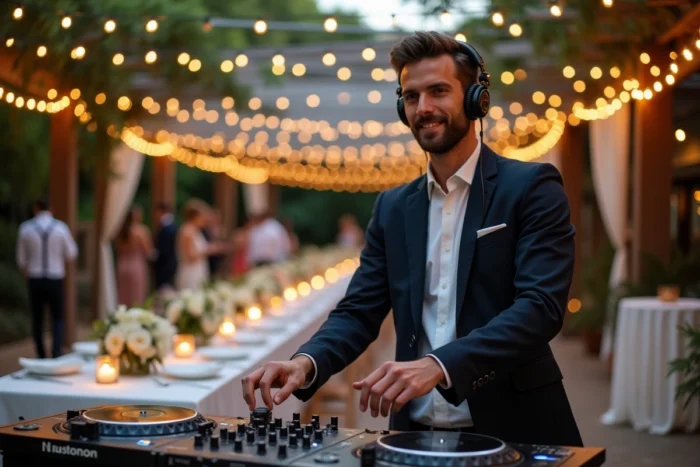
The wedding DJ market in France is experiencing increasing pressure on peak season dates. Between May and September, Saturdays are often booked more than a year in advance for recognized providers. This pressure on the calendar pushes many couples to make quicker decisions, sometimes at the expense of a thoughtful choice. However, the DJ remains the provider that most directly influences the energy of the dance party and, by extension, the memory that guests will keep.
Venue Constraints and Choosing a Wedding DJ
Classic guides rarely address a determining factor: the configuration of the venue. A listed castle, a renovated barn, or an outdoor estate impose different acoustic constraints and installation possibilities.
A DJ accustomed to heritage venues knows, for example, that they will have to deal with vaulted ceilings that amplify bass, or with restrictions on mounting equipment to the walls. In an outdoor space, sound diffusion dissipates more quickly, requiring more powerful sound equipment and strategic placement of speakers.
Before contacting a provider, identify the specifics of your venue. If your reception takes place in multiple areas (outdoor civil ceremony, cocktail under a pavilion, indoor evening), the DJ will need to manage multiple sound zones with appropriate equipment. Not all professionals have this logistics. This is an effective sorting criterion from the first exchange.
To deepen this research, knowing how to find a good DJ for your wedding on La Mariée Rêveuse helps refine your criteria even before the first meetings.
Sound and Lighting Equipment: What the Quote Should Detail
A wedding DJ quote that simply mentions “sound and lights” without specifics should raise a red flag. The quality of the equipment determines the listening comfort during cocktail music as well as the energy on the dance floor at the end of the evening.
Here are the points to check in a quote:
- The type and power of the speakers, in relation to the size of the venue. A space larger than 200 m² requires a different configuration than an intimate lounge.
- The presence of a return or monitoring system, useful if the DJ also needs to sound the speeches or the ceremony.
- The details of the proposed lighting: LED spotlights, ambient light shows, possibly architectural lighting. Lighting often represents half of the visual impact of an evening.
- The backup equipment planned in case of failure (spare cables, additional turntable, backup power supply).
Some couples discover on the big day that their DJ works with undersized equipment. Asking these technical questions in advance, even without being a specialist, forces the provider to detail their service and allows for comparing offers on concrete bases.
Wedding DJ Pricing: Understanding What Affects the Price
Recent guides indicate that a complete wedding DJ service (6 to 8 hours, sound and lights) starts around 890 euros in France. This base price can vary significantly based on several parameters.
The duration of the service is the first lever. A DJ hired from the cocktail hour until the end of the dance party logically charges more than one limited to the dance evening. The distance between the DJ’s home and the venue also comes into play, with some providers charging travel fees beyond a certain radius.
The experience and reputation of the professional also weigh in. A DJ who has performed at several hundred weddings and has verifiable recommendations will charge higher rates. Feedback on this point varies: a high price does not automatically guarantee a better atmosphere, but it generally reflects a more significant investment in equipment and preparation.
Beware of abnormally low rates. They sometimes correspond to occasional DJs who do not have professional liability insurance or compliant equipment. Always request a proof of insurance before signing.
Animation Style and Music Programming: Asking the Right Questions
The animation style varies greatly from one DJ to another, and it is probably the most subjective criterion. Some couples want a smooth evening where the music naturally guides guests to the dance floor. Others seek a more interactive animation, with a DJ very present on the microphone, games, and spoken interludes.
A recent trend, inspired by the “sound system” format, offers a rapid succession of short tracks and rhythmic interludes. This very dynamic format appeals to some couples but can unsettle a less accustomed audience. Discuss this topic during the preliminary meeting to ensure that the DJ adapts their style to the profile of your guests.

The elements to clarify with your DJ before the wedding:
- The possibility of providing a playlist of desired tracks and, especially, a list of tracks to avoid.
- Their ability to read the atmosphere in real-time and adjust the music programming according to the energy on the dance floor.
- Their approach to transitions between key moments (first slow dance, opening dance, bouquet toss) and quieter moments.
An experienced wedding DJ asks as many questions as they receive. If they do not ask you about the age range of your guests, your musical tastes, or the precise flow of the evening, consider this a warning sign.
Pre-Meeting with the DJ: What It Really Reveals
The meeting before the wedding, whether it takes place via video or in person, remains the best filter. Beyond the feeling, observe the professional’s method. A structured DJ arrives with specific questions about the venue, the number of guests, and any sound restrictions imposed by the town hall or the property owner.
This meeting also allows you to check a point often overlooked: coordination with other providers. The DJ should be able to communicate with the caterer about the timing of the meal, with the photographer about key moments to capture, and sometimes with the master of ceremonies if you have one. A professional who refuses to integrate into this coordination chain risks creating discrepancies on the big day.
Ultimately, the choice of DJ comes down to three concrete criteria: their technical mastery of the equipment and venue, their ability to adapt to the profile of your guests, and their rigor in preparation beforehand. The rest is based on personal feelings during this first exchange.