Your last Sunday afternoon probably looked a lot like the one before: a movie playing in the background, the couch, and that vague feeling of having let a few hours slip by without getting much out of it. Free time, when not directed, often ends up dissipating. However, finding an activity that truly suits you requires less effort than one might think, as long as you know where to look and, most importantly, understand what really motivates you.
Immersive Leisure: Why Gamified Experiences Are Game Changers
Have you ever walked into an escape room with friends or family? This type of activity illustrates an underlying trend. So-called “immersive” leisure activities (next-generation escape rooms, virtual reality rooms, interactive theme parks) are experiencing rapid expansion.
According to Fortune Business Insights, the global location-based entertainment market is valued at $5.17 billion in 2024, with an estimated annual growth rate of 20.9%. This means that more and more venues are opening near you, offering scenarios where you become an actor rather than a spectator.
Solving puzzles as a team, racing against the clock, unlocking clues: the gamification mechanics applied to the real world provide the brain with regular rewards that maintain engagement. By 2025, about 70% of consumers are expected to have experienced at least one gamified experience, according to experts cited by Fortune Business Insights.
Exploring leisure activities on Influence News allows you to spot these new activities before they become saturated on weekends.

Leisure Sports Activities: The Boom of Structured Practices
Sports remain a reliable value in free time. The enthusiasm for structured outdoor activities shows no signs of waning, driven by accessible formats and a growing number of offerings across the territory.
Why “structured”? Because the trend is moving away from solitary jogging. Commercial sports leisure activities are showing double-digit growth, driven by short and accessible formats: indoor climbing sessions, padel classes with friends, sailing courses for a weekend. The common point of these practices is that they require neither an annual subscription nor prior experience.
Choose According to Your Profile and Schedule
The classic mistake is to sign up for an activity that is too demanding, only to give up after three sessions. To avoid this pattern, a few concrete criteria help to sort:
- The realistic frequency: an activity you can practice at least twice a month without reorganizing your entire schedule is more likely to last than a rigid weekly class.
- The actual budget: some activities (hiking, running, recreational beachcombing) require almost no equipment, while a VR session indoors or a sailing course involves a cost per session to anticipate.
- The social format: practicing alone, with family, or with friends does not mobilize the same motivation. A team sport or a group workshop creates an appointment that engages you more.
Creative and Intellectual Leisure at Home: Going Beyond the Generic List
Articles on the subject often line up the same suggestions: cooking, reading, puzzles, gardening. These ideas are still valid, but they pose a problem: they say nothing about what makes you stick to them.
Take cooking, for example. Following a YouTube recipe on a Sunday evening is enjoyable. Starting a small monthly cooking club with three or four close friends, where everyone prepares a dish around a set theme, is a structured leisure activity that creates anticipation and excitement. The difference lies in the framework, not in the activity itself.
Learning Online Without Falling into Course Accumulation
Online course platforms have democratized access to almost all knowledge. The trap is signing up for five courses simultaneously and finishing none.
A more effective method is to choose one subject per quarter and practice it, not just watch it. Learning the basics of drawing, for instance, is only valuable if you actually draw between videos. The online course provides the theory; the leisure begins when you close the screen and apply it.

Leisure with Family and Friends: What Really Creates Bonds
Have you ever noticed that some family outings leave a strong memory, while others fade within a few days? The difference rarely lies in the price or the destination. It lies in the interaction.
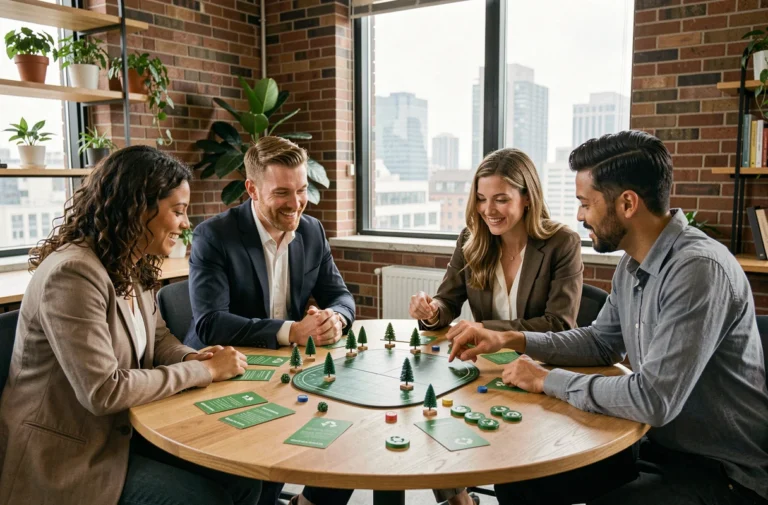
An afternoon in an immersive park where parents and children collaborate to solve challenges leaves a stronger impression than a passive visit. Similarly, a well-chosen board game session (especially cooperative ones) generates more conversation than a movie watched in silence side by side.
- With young children: short creative workshops (painting, modeling clay, building) work better than long activities that exceed their attention span.
- With teenagers: escape rooms, virtual reality sessions, or small group sports challenges capture their attention much more than a mandatory cultural outing.
- Among adult friends: “event” formats (home quiz night, hiking with a picnic, cooking class for four) create a ritual that naturally renews itself.
The common thread, in all cases, remains the same: a shared leisure activity is valuable for the interaction it provokes, not for the location or budget.
Finding the Right Balance Between Active Leisure and Quiet Time
Filling every free slot with an activity is not the goal. Free time also needs unprogrammed stretches to remain restful. The idea is not to turn your week into a leisure agenda, but to integrate one or two activities that truly matter.
A good indicator: if you look forward to your next session with a bit of impatience, it means the activity has found its place. If you consistently postpone it, the problem lies in the format, not in your motivation. Change the frequency, the setting, or the people accompanying you before changing the activity.
The best leisure activity is not the most original or trendy. It is the one you will still be practicing in six months because it fits into your life as it is, not as you would like it to be.