Back to school 2026 in French schools: what measures are truly changing the game for students, teachers, and families? Between the consolidation of ongoing reforms, new digital obligations, and a reinforced focus on struggling institutions, the measures announced for the 2026-2027 school year outline clear priorities. The challenge remains to measure the gap between the stated ambitions and the resources deployed on the ground.
New educational measures 2026: comparative table of key measures
Several initiatives will come into effect simultaneously at the start of the 2026 school year. To clarify, a comparison allows us to distinguish their scope, target audience, and timeline.
| Measure | Target Audience | Scope | Timeline |
|---|---|---|---|
| Colleges in Progress | Struggling middle school students | About 800 colleges where more than 40% of students scored below 8/20 on the diploma | Start of 2026, support over two years |
| Ban on social media for under 15s | All minors under 15 | National (law of August 24, 2026) | Effective from the start of 2026 |
| Ban on mobile phones from school to high school | Students from primary to high school | National | Start of 2026 |
| New programs (gradual implementation) | Students from kindergarten to middle school | National | Gradual, starting in 2026 |
This table highlights a trend: the 2026 school year does not launch any new structural reforms. It consolidates and targets. The Colleges in Progress initiative, for example, is based on a specific numerical threshold to identify the most vulnerable institutions. The two standardized days per year for collective work on teaching practices reflect a long-term support logic, not just a superficial display.
Media outlets like Échos D’École relay these developments throughout the school year, allowing families and educational teams to follow the concrete implementation of each measure.
Colleges in Progress: an unprecedented targeting of fragile institutions
The Colleges in Progress initiative marks a turning point in the priority education policy. The chosen criterion is precise: more than 40% of students scoring below 8/20 in French and mathematics on the diploma. This threshold does not strictly overlap with the traditional priority education map (REP, REP+). Some colleges outside the priority network may qualify, while others already classified as REP do not meet this threshold.
The planned support is based on two standardized days per year, dedicated to team work on teaching practices. The principle is to move away from a top-down approach (circular, then individual application) to structure a collective reflection time among teachers within the institution.
However, the back-to-school circular for 2026 does not detail the additional human resources allocated to these colleges. The issue of replacements during standardized days and the continuing education of the involved teachers remains open. The initiative relies on existing resources, with no announcement of new positions.
What indicators to measure progress?
The ministry sets a two-year horizon. Results on the diploma will be the main monitoring indicator. This choice has the merit of clarity, but it overlooks other dimensions: school climate, dropout rates, post-third orientation.
A college can improve its diploma results without the well-being of students or the stability of teaching teams progressing at the same pace. The evaluation of this initiative will require monitoring across several criteria, not just a success rate.
Ban on phones and social media: real impact in French schools
Two converging measures now regulate the use of digital technology among young people. The ban on mobile phones extends from school to high school, and the law of August 24, 2026 prohibits social media for those under 15.
The extension to high school represents the most visible change. In practice, the implementation largely depends on each institution’s internal regulations. Some high schools had already anticipated the measure, while others will need to adapt their monitoring and storage practices for devices.
Reasoned digital use and classroom learning
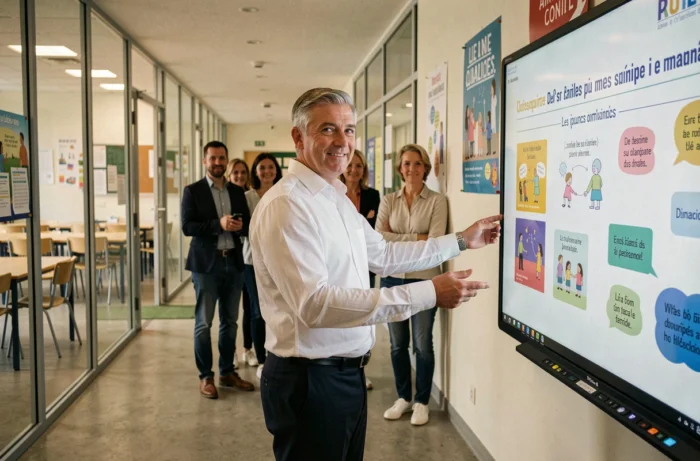
The back-to-school circular for 2026 speaks of “reasoned digital use.” The goal is not to eliminate digital tools from teaching but to distinguish between supervised pedagogical uses and unsupervised recreational uses. Artificial intelligence in education, for example, remains encouraged within a structured pedagogical framework.
Institutions that have integrated tablets or computers into their teaching are not affected by the ban. The boundary lies between personal devices (phones, smartwatches) and equipment provided by the institution.
- Mobile phones must be turned off and stored upon entering the institution, from primary school to high school.
- Pedagogical digital tools (tablets, classroom computers) remain permitted under teacher supervision.
- The law on social media requires platforms to verify age, directly impacting prevention policies in schools.
- Educational teams are encouraged to incorporate the issue of digital use into school projects.
School programs and teacher training: what changes in 2026-2027
The new programs will gradually come into effect from kindergarten to middle school. The back-to-school circular emphasizes mastery of language and mathematics as pedagogical priorities. The ministerial instruction is to prefer “depth” over “breadth”, meaning to deepen the fundamentals rather than multiply objectives.
The reform of initial teacher training, initiated in previous years, continues without major changes. The framework remains one of consolidation. For in-service teachers, research in educational sciences and field feedback inform the content of continuing education, but no large-scale supplementary training plan is announced for this school year.
The priorities for the 2026-2027 school year can be summarized in two axes: educate and protect. This deliberately narrowed formulation reflects a choice to refocus, after several years of successive reforms that had fragmented the objectives assigned to educational teams.
The most revealing data for this school year remains the threshold of 40% of students scoring below 8/20 set for the Colleges in Progress. This figure establishes a concrete, measurable benchmark and commits the ministry to an observable result within two years. The outcome will depend as much on the actual resources allocated as on the capacity of the teams to transform these standardized days into a sustainable pedagogical lever.