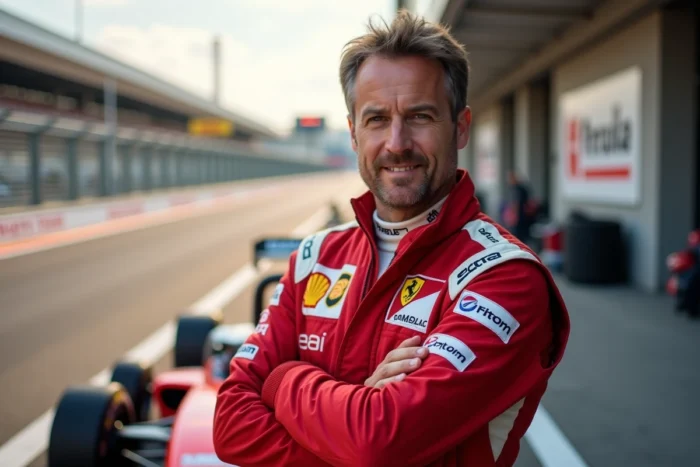
The displayed price of a driving course rarely reflects the actual value of what you will experience on the track. Two packages at the same price can offer radically different experiences depending on the actual driving time, the instructor/student ratio, and the quality of technical supervision. We recommend dissecting each offer with the same rigor as a specifications document before booking.
Actual driving time and supervision density on the track
The first reflex is to check the actual track time, not the overall duration of the day. A package advertised for half a day may boil down to just a few timed laps once you subtract the theoretical briefing, rotations between students, and technical breaks. We observe that most commercial sites highlight the total duration of the event rather than the actual minutes spent behind the wheel.
The instructor/student ratio is another decisive variable. Individual or paired supervision allows for debriefs between each stint, with trajectory analysis and braking correction. Beyond four students per instructor, the support dilutes and the course resembles a simple recreational lap. Demand this information before any booking.
This level of transparency about the program is rare in consumer offers, and seeking personalized support on vitesseetliberte.fr allows you to compare packages based on these concrete criteria rather than just the name of the car.
Passenger lap with an instructor: the underestimated sequence of the driving course
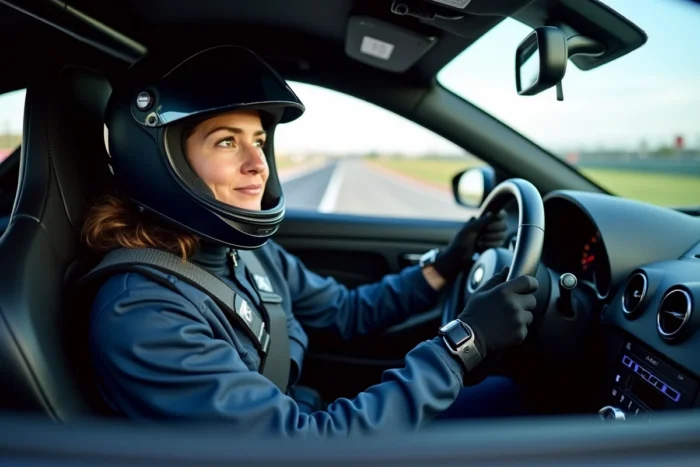
Competing guides focus their arguments on the choice between GT and single-seater, the layout of the track, or the catalog of available brands. They overlook an element that students consistently cite as the most memorable moment of the day: the passenger lap alongside a professional driver.
This lap is not just a marketing bonus. It is a demonstration of trajectories, braking points, and accelerations that the student cannot replicate alone during their first laps. Observing an instructor’s track reading at real speed provides visual and physical references that are impossible to convey in a briefing room.
Not all packages include this passenger lap, or they offer it as a paid option. We recommend considering it as a selection criterion in its own right, just like the number of laps behind the wheel. A course without this sequence loses a significant educational dimension.
Weather conditions and track reading
Rain on the track is often perceived as an inconvenience. This is a misjudgment. Driving on a wet track reveals the technical quality of a course much more than driving on dry asphalt. Reduced grip forces you to refine your support, braking modulation, and trajectory smoothness in turns.
Good supervision exploits these conditions to teach oversteer and understeer management at accessible speeds. A course that cancels or degrades the experience in case of rain indicates a lack of educational depth.
Paddock quality and ground organization: what photos don’t show
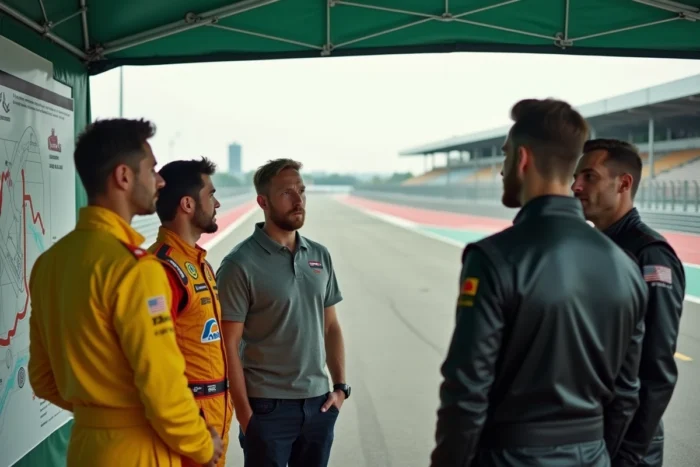
The atmosphere of the paddock is an integral part of the experience, and not just as a backdrop. Observing the instructors’ test laps, access to the pits, and the opportunity to see mechanical adjustments between sessions transform waiting times into learning sequences. A well-organized paddock maintains immersion between driving stints.
Check these points before booking:
- Access to a viewing area by the track with an unobstructed view of the technical turns, not just the straightaway
- The presence of a debriefing area with visual support (onboard video, commented layout) to analyze the laps between each session
- The number of cars on track simultaneously, which directly affects the fluidity of driving and safety
A paddock that looks like a dealership parking lot does not have the same effect as a facility organized around the track with real access to technical aspects.
Single-seater or GT driving course: the choice based on objectives, not prestige
The single-seater or GT question comes up in all guides, but it is often asked from the angle of automotive dreams. We pose it differently: what technical learning are you looking for?
The single-seater (Formula Renault, Formula 4) places the driver alone in the cockpit, in a reclined position, with a power-to-weight ratio that amplifies every trajectory error. Driving a single-seater immediately penalizes approximations, making it a rapid progression tool for a student already comfortable on the track.
The GT (Porsche, Ferrari, Lamborghini) allows for the presence of an instructor in the passenger seat. This setup enables real-time coaching, turn by turn. For a first course, this formula generally produces a more structured learning experience because the verbal feedback is immediate.
The choice is therefore not limited to a brand preference or sensations. It depends on your current level and what you concretely expect from the session:
- Discovery and guided progression: GT with instructor onboard
- Pure sensations and autonomy: single-seater on a technical track
- Trajectory refinement: competition GT (like Cup or GT3) with onboard telemetry
The trap of the brand catalog
A provider that highlights twenty different models does not guarantee a better experience than another that offers three. The diversity of the fleet sometimes hides a business model based on volume, with short sessions and standardized supervision. The quality of the course is measured by the time spent on the track and the instructor’s competence, not by the number of logos on the brochure.
Prioritize structures that publish detailed content for each package: driving duration, number of laps, supervision ratio, inclusion or not of the passenger lap. These details, when absent from the booking page, justify a direct call before any purchase. A provider that hesitates to answer these points precisely already informs you about the transparency of their offer.