
When installing a snack counter on a central island or extending the work surface, the first challenge is not the choice of material or the color of the countertop. It’s the height. If it’s too high, you’re perched on an uncomfortable stool. If it’s too low, you end up hunched over, your knees trapped under the countertop. The snack counter in the kitchen requires considering three measurements before fixing anything.
Height, depth, and seating: the basics before drilling
The question is often reduced to a single number, that of the countertop height. In practice, this number alone is not enough. A snack counter is dimensioned as a set of three inseparable measurements: countertop height, seat-countertop gap, and overhang depth.
The gap between the stool seat and the underside of the countertop should be between 25 and 30 cm. Below that, the thighs hit. Above that, you feel too low, with elbows in the air. The overhang depth should reach at least 25 to 30 cm to accommodate the knees without forcing the posture.
Specifically, if a countertop is set at 90 cm, you should look for stools with a seat height around 62 to 65 cm. If the countertop rises to 110 cm, you need high stools with a seat close to 80 cm, and a footrest becomes essential. As advised by La Cigale et la Fourchette, these combined measurements determine the actual comfort on a daily basis much more than the raw height of the counter alone.
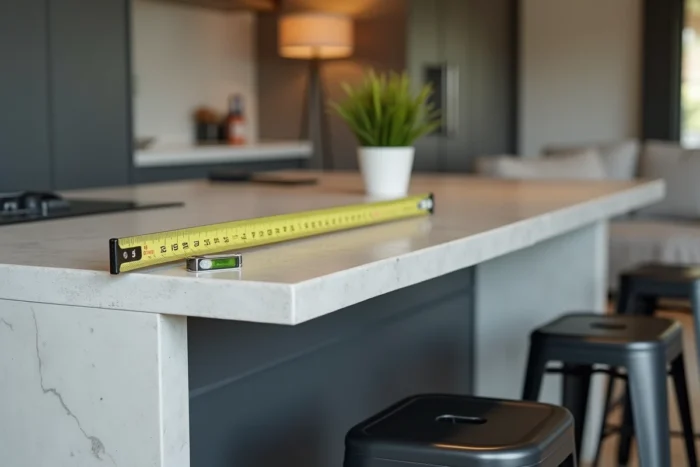
Snack counter height according to use: daily meals or standing dining
Kitchen designers increasingly distinguish two main usage families, and the height directly results from this choice.
Snack counter for daily meals
When the snack counter is used for breakfast, quick lunches for kids, or weeknight dinners, a height around 90 cm remains the most comfortable reference. You sit on mid-height stools, with feet easily resting on a bar or almost touching the floor. This setup limits fatigue during meals that last more than twenty minutes.
It is also the easiest height to connect to the existing work surface, as most standard kitchens are set between 87 and 92 cm. The snack countertop can then extend in the same plane, without any drop.
Standing dining or bar counter
For more occasional use (aperitif, coffee, quick break), the height rises to between 105 and 110 cm. The atmosphere changes: it approaches that of a bar or bistro counter. High stools with footrests become mandatory, and sufficient clearance must be provided so that legs do not hit the structure of the island.
Feedback varies on this point, but beyond 110 cm, comfort significantly decreases for the majority of users, including tall individuals.
Adjusting the snack counter height to user morphology
The most reliable ergonomic rule for setting the height is to position the countertop 10 to 15 cm below the elbow of the user standing, with arms bent at 90°. This method goes beyond the simple reference to the standard 90 cm and allows for personalizing the height according to the actual morphology of the household.
For a person around 1.60 m tall, the elbow is generally lower, and a countertop at 85-88 cm may be more suitable. For someone over 1.85 m, it often exceeds 95 cm. In a household where heights vary greatly, the preference is given to the person who uses the snack counter most often, and adjustments are made for others with height-adjustable stools.
- Measure the distance from the floor to the elbow (arms bent) of the main user, then subtract 10 to 15 cm to obtain the target countertop height.
- Choose stools with adjustable seats if several people of different heights share the snack counter daily.
- Ensure that the countertop overhang leaves at least 25 cm of free depth for the knees, regardless of the stool selected.

Common mistakes when choosing the height of a snack counter
On-site, the same problems always arise once the counter is installed. Buying stools after fixing the countertop height, rather than the other way around, remains the main source of error. You end up with a seat-counter gap that is out of standard, impossible to correct without changing the seat.
Another trap: aligning the snack counter to bar height without considering the depth of the island. A countertop at 110 cm with only 20 cm of overhang makes the seating very uncomfortable, as the knees hit against the furniture. You gain in aesthetics what you lose in functionality.
- Don’t forget the thickness of the countertop in the calculation. A stone or solid wood countertop can add 3 to 5 cm compared to a thin laminate, which shifts the entire chain of measurements.
- Plan for at least 60 cm of free space under the countertop in width per seating place, otherwise you will interfere with each other.
- Test the configuration with a temporary cardboard at the right height before drilling or ordering a custom countertop. Ten minutes of testing can avoid disassembly.
The choice of the height of a snack counter in the kitchen relies on precise measurements, not on intuition. A well-positioned countertop between 90 and 110 cm, combined with stools whose seat respects the 25 to 30 cm gap, transforms a simple counter into a true dining area. Just measure your elbow, grab a tape measure, and place a cardboard before pulling out the drill.