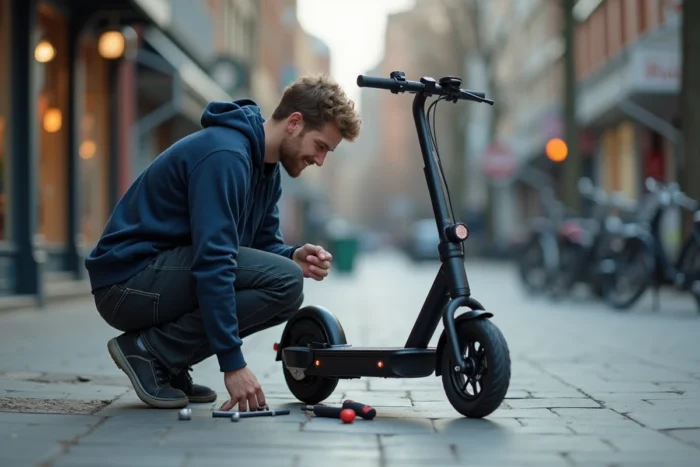
The Urban Glide 140 electric balance bike breaks down, and the first instinct is often to look for customer service or to buy a replacement part. In most cases, the problem comes from a loose connection, a forgotten adjustment, or a poorly maintained battery. Identifying the exact cause before taking action prevents replacing a part that is still functional.
Connections and loose contacts on the Urban Glide 140: the invisible breakdown
Have you noticed that the balance bike lights up but refuses to move? Or that it suddenly stops while riding? The most common culprit is neither the motor nor the controller, but a simple cable that is not properly connected.
On the Bike 140, the connectors located under the handlebars and at the steering tube experience vibrations with every ride. Over time, a plug can loosen by a few millimeters, which is enough to interrupt the signal between the throttle and the controller.
To check, turn off the balance bike, then inspect each connector one by one. Disconnect it, blow on the pins to remove dust, then reconnect firmly until you hear a click. Focus on three areas:
- The connection between the throttle (right handle) and the main harness, often hidden in the steering column.
- The electronic brake connector, which can cut off the motor power if it remains in the “brake activated” position due to a poor contact.
- The plug connecting the battery to the controller, accessible under the seat or the platform depending on the version.
If you encounter other common problems with the Urban Glide 140, this connectivity check resolves a good portion of cases without tools or special skills.
Error codes E1 and E5: electronic diagnosis of the balance bike
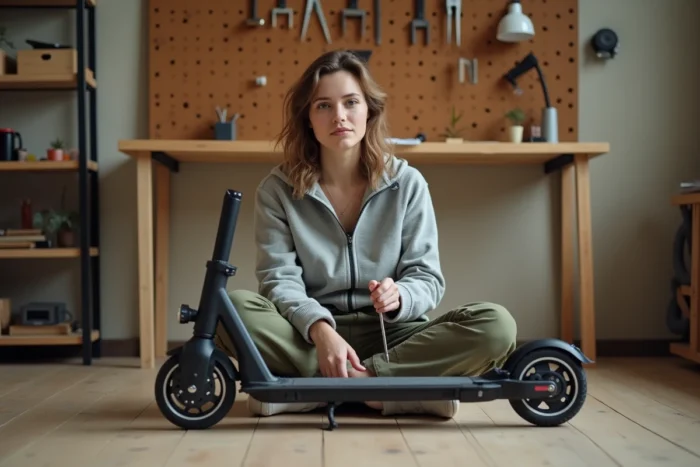
An error code displayed on the LCD screen means that the controller has detected an anomaly. On the UrbanGlide range of balance bikes and electric scooters, the codes E1 and E5 are the most common.
Code E1: motor or sensor problem
The E1 code indicates a communication break between the motor and the controller. Before suspecting the motor itself, check the cable that runs from the rear wheel up to the frame. A pinched wire against the fender or an oxidized connector can trigger this code without damaging the motor.
If the cable is intact and properly connected, turn the rear wheel by hand while the balance bike is on. A wheel that turns freely without abnormal magnetic resistance indicates that the motor is functioning. The problem then lies with the controller or the Hall effect sensor located in the hub.
Code E5: braking anomaly
The E5 code corresponds to a brake that remains in the active position. On the Bike 140, the brake lever contains a micro-switch that cuts off the motor as soon as you brake. If this micro-switch gets stuck (due to dust, shock, humidity), the controller thinks you are constantly braking and blocks any acceleration.
Press the affected brake lever several times quickly to release the mechanism. If the code persists, disconnect the brake connector, turn the balance bike back on, and test. The disappearance of the code confirms that the brake sensor is defective and needs to be replaced.
Urban Glide 140 battery not charging: checks to perform
A battery that refuses to charge is not necessarily dead. The charger itself is the first cause to eliminate. Plug it in by itself to the wall outlet: the indicator should turn green and then red when you connect the balance bike. If no indicator lights up, the charger is at fault.
Also check the charging port on the balance bike. A bent pin or moisture in the port prevents contact. A dry cotton swab is enough to clean the inside.
If the charger works but the battery no longer takes a charge, leave the charger plugged in for at least two hours even if nothing seems to happen. Lithium-ion batteries in low voltage protection require a “wake-up” time before current flows again. This phenomenon occurs especially after several weeks without use.
Tires and mechanical wear: preventive maintenance of the Bike 140
The Bike 140 is designed for short trips on smooth surfaces. Regular use on degraded surfaces accelerates tire and braking system wear. The solid tires on some versions do not puncture, but lose their grip once the tread is worn smooth.
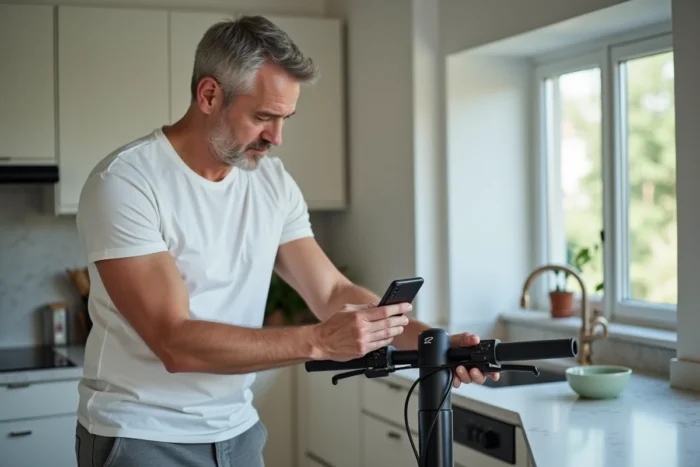
The handlebars also deserve regular attention. Vibrations gradually loosen the folding clamp screw. A handlebar that has lateral play alters the direction and can cause a loose contact in the cables that run inside the column.
Before each ride, three quick gestures reduce the risk of breakdown:
- Gently shake the handlebars to detect abnormal play, then tighten if necessary with an Allen key.
- Check that the brake levers return to the neutral position after being pressed.
- Visually inspect the condition of visible cables, especially at the frame’s folding points.
The majority of breakdowns with the Urban Glide 140 boil down to a connectivity issue, a stuck brake sensor, or a battery in low voltage sleep mode. A methodical diagnosis, zone by zone, prevents unnecessary part replacements. Keep an Allen key and a dry cloth in your bag: these are the two tools that cover most interventions on this balance bike.