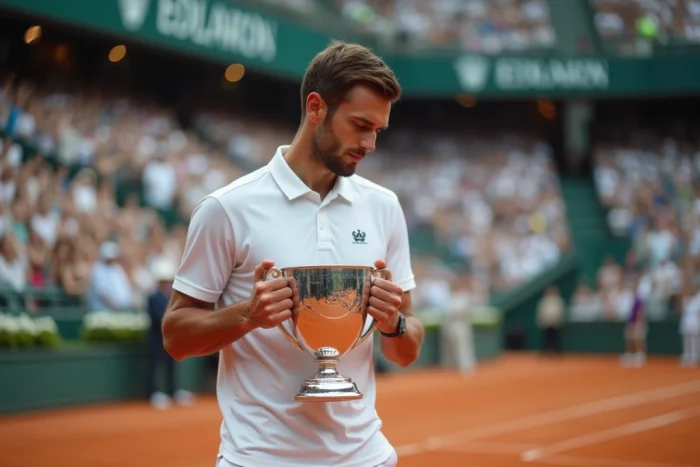
Winning all four major tennis tournaments in a single season remains one of the rarest feats in professional sports. The Australian Open, Roland-Garros, Wimbledon, and the US Open are played on different surfaces, under opposing climatic conditions, against specialized opponents. Since the term has existed, the calendar Grand Slam has only been achieved a handful of times, and each failed attempt serves as a reminder of the enormity of the goal.
What the surfaces impose on contenders for the calendar Grand Slam
The technical difficulty of the calendar Grand Slam lies less in the number of matches than in the variety of surfaces. A player must excel on hard (Australian Open), clay (Roland-Garros), grass (Wimbledon), and then back to hard (US Open), all within a few months.
Clay slows down the ball and favors long rallies, controlled slides, and topspin effects. Grass produces the opposite: low bounces, short points, and an advantage for serving. Transitioning from one to the other in a matter of weeks requires a level of physical and tactical adaptability that very few players master at the highest level.
For this reason, several champions with exceptional records have never completed the feat. Roger Federer, despite his titles on all surfaces, has never won all four in the same year. Rafael Nadal, dominant on clay, has often stumbled on the London grass at the wrong moment. The question of who has achieved the 4 Grand Slams in the same season always refers back to a short list of names, precisely because total versatility across four surfaces remains exceptional.
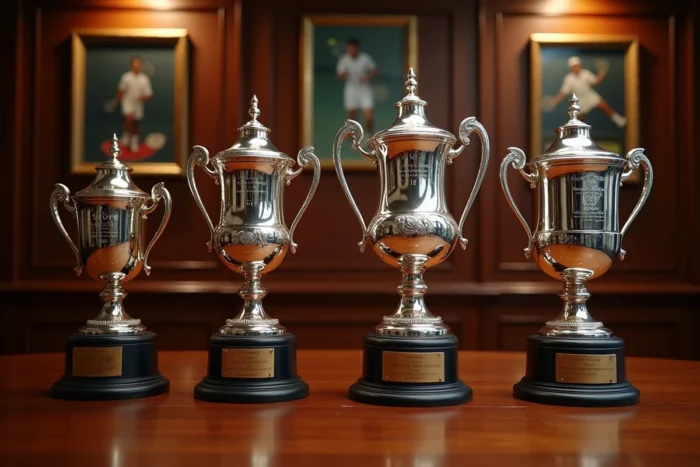
Donald Budge in 1938 and Rod Laver in 1962 and 1969: the pioneers of the Grand Slam
Donald Budge is the first player to achieve the calendar Grand Slam, in 1938. The context was different from today: tennis was still amateur, intercontinental travel took weeks, and the pool of international players was smaller. The feat remains foundational as it named the ultimate goal of tennis.
Rod Laver took it a step further. The Australian accomplished the calendar Grand Slam twice: in 1962, while still an amateur, and then in 1969, after tennis opened up to professionals. Laver remains the only male player to have achieved the calendar Grand Slam twice.
The distinction between Laver’s two achievements deserves attention. In 1962, the best professionals of the time did not participate in the major tournaments. In 1969, after the start of the Open era, all players in the world were on the circuit. Thus, the second performance carries a significantly heavier competitive weight.
Steffi Graf and the Golden Grand Slam of 1988
Among women, Steffi Graf achieved the calendar Grand Slam in 1988, winning the Australian Open, Roland-Garros, Wimbledon, and the US Open in the same year. She also added the Olympic gold medal at the Seoul Games, which gave rise to the term “Golden Grand Slam.”
Graf’s 1988 season represents a unique case in tennis history. No player has since replicated this combination of the four Majors and Olympic gold in a single season.
Maureen Connolly accomplished the calendar Grand Slam in 1953, and Margaret Court in 1970. These female feats are sometimes less cited than those of Laver or Budge, even though they involve the same competitive demands across the four surfaces.
Players who achieved the calendar Grand Slam in singles
- Maureen Connolly in 1953, at a time when women’s tennis was beginning to structure itself internationally
- Margaret Court in 1970, the same year as the expansion of the Open era, with a total Grand Slam title count that remains the highest in history
- Steffi Graf in 1988, the only player to combine the four Majors and Olympic gold in the same year
Novak Djokovic and the unfinished quest for the men’s calendar Grand Slam
Since Rod Laver in 1969, no male player has achieved the calendar Grand Slam. Novak Djokovic is the one who has come closest. In 2021, the Serbian won the Australian Open, Roland-Garros, and Wimbledon before reaching the final of the US Open, where he was defeated.
More than half a century separates the last men’s calendar Grand Slam from current tennis. This gap illustrates the elevation of the level of competition. The ATP circuit now has more players capable of beating anyone on a given surface, making a series of four consecutive Major victories even more improbable.
The available data does not allow us to conclude that the men’s calendar Grand Slam has become impossible. However, the structural conditions of modern tennis (dense schedule, depth of the player pool, surface specialization) make each attempt more fragile than in Laver’s time.
Commercial storytelling and audiences: the economic stakes of a potential Grand Slam
A rarely addressed angle concerns the economic dimension of the quest for the calendar Grand Slam. When a player arrives at the US Open with three Majors in hand, organizers and media build a commercial narrative around this issue, with significantly higher television audiences and advertising revenues.
The US Open, the last Grand Slam tournament of the season, directly benefits from this drama. The possibility that a player completes the calendar Grand Slam transforms an already major sporting event into a potential historic moment, attracting an audience far beyond regular tennis fans.
This media and financial pressure also weighs on the player involved. Djokovic in 2021 played his US Open final under the weight of global expectation, in a context where every point carried an enormous emotional burden. The calendar Grand Slam is not just a sporting challenge; it is also a media product.
The calendar Grand Slam remains the pinnacle of individual tennis. Five players have achieved it in singles: Budge, Connolly, Laver (twice), Court, and Graf. The fact that the list can be counted on one hand, despite decades of professional tennis and the emergence of champions with colossal records, speaks volumes about the difficulty of the endeavor.