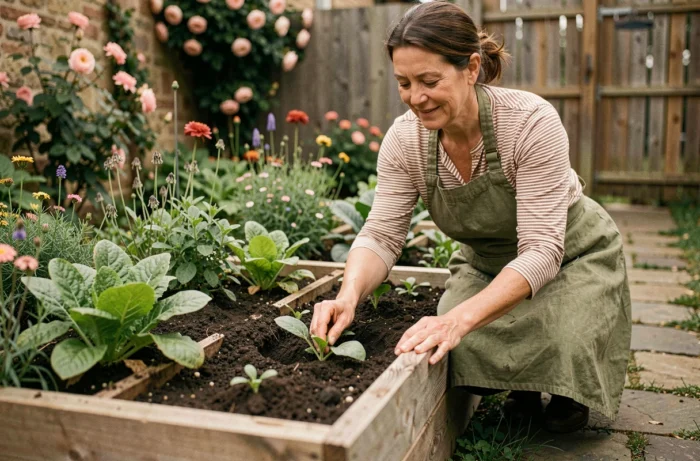
A garden that remains vibrant in January as in July relies on choices made well before the first planting. The secret to a flourishing garden all year round lies less in the quantity of plants than in their complementarity: staggered flowering periods, evergreen foliage, and hardy perennials capable of surviving frost. Before choosing anything at the nursery, two parameters condition everything else: the nature of the soil and the actual exposure of each area of the land.
Soil and Exposure: The Diagnosis Most Gardeners Overlook
Have you ever noticed that some plants struggle in a specific spot while they thrive at a neighbor’s? The reason is almost always related to the soil or light. Clay soil retains water, which drowns the roots of lavenders or rosemary. Sandy soil, on the other hand, lets nutrients slip away too quickly for hungry hydrangeas.
To know the texture of your soil, take a handful of damp earth and squeeze it. If it forms a compact ball that doesn’t crumble, you have clay soil. If it disintegrates between your fingers, the soil is more sandy. A soil that holds its shape but crumbles under slight pressure is a balanced soil, known as loamy.
Mapping out shaded and sunny areas over an entire day radically changes the success of plantings. A north-facing bed will receive less than four hours of direct sunlight, even in summer. Reserve it for ferns, hostas, or hellebores rather than roses or tomatoes. This distribution is the foundation of lighter maintenance, as a plant in the right spot requires less watering, less fertilizer, and is more resistant to diseases.
Specialized resources like lemondedujardin.com allow for a deeper exploration of the choice of plants suited to each type of terrain.
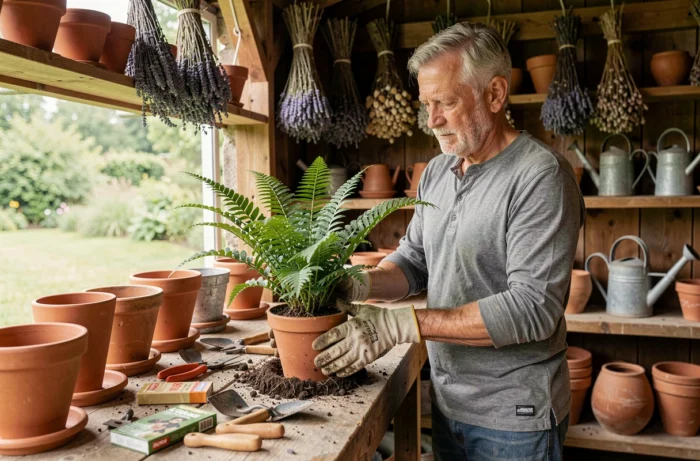
Staggering Flowering Season by Season
A garden that flourishes all year does not rely on a single category of plants. The principle is simple: each month must have at least one plant in bloom or with decorative foliage.
The Relay of Perennials and Shrubs
In practice, this means composing groups that take turns. Hellebores and snowdrops kick off the show at the end of winter. Daffodils and grape hyacinths take over in early spring, followed by peonies and irises in May. Summer is covered by echinaceas, sages, and agapanthus. In autumn, asters and Japanese anemones extend the color until the first frosts.
For winter, focus on evergreen foliage. A mahonia offers fragrant yellow clusters in December. The red-twig dogwood (Cornus alba) provides structural color even without leaves. Ornamental grasses retain their dry spikes all winter and create movement when the wind passes through.
Combining Annuals and Biennials to Fill Gaps
Perennials form the backbone of the garden, but they sometimes leave gaps between two flowering periods. Annuals (cosmos, zinnias, nasturtiums) and biennials (pansies, wallflowers) are precisely used to fill these empty periods. Sown directly in place or transplanted from pots, they cover the ground in a few weeks.
Watering and Rainwater Harvesting: What Has Changed Recently
Watering is the most resource-intensive aspect of a garden, and French regulations have evolved. Decree No. 2024-796 and the order of July 12, 2024, have restructured the framework for using non-potable water for domestic purposes. The old order from 2008 is now repealed.
In practical terms, watering the garden with rainwater is explicitly allowed without any special procedure, provided that the installation remains outdoors. A tank connected to a gutter and linked to a hose does not require any declaration at the town hall. It is the connection to the home’s internal network (toilets, washing machines) that requires a declaration.
This distinction is useful to remember: installing a rainwater collector dedicated to the garden is the simplest solution, without administrative procedures. For a medium-sized garden, a tank of a few hundred liters covers a good part of summer needs if combined with good watering practices.
- Water early in the morning or late in the day to limit evaporation, especially during periods of prefectural restrictions.
- Always mulch the beds and vegetable garden with wood chips, straw, or fallen leaves: mulching significantly reduces water needs.
- Prefer watering at the base (drip irrigation, watering can) rather than by spraying, which wets the foliage and promotes fungal diseases.
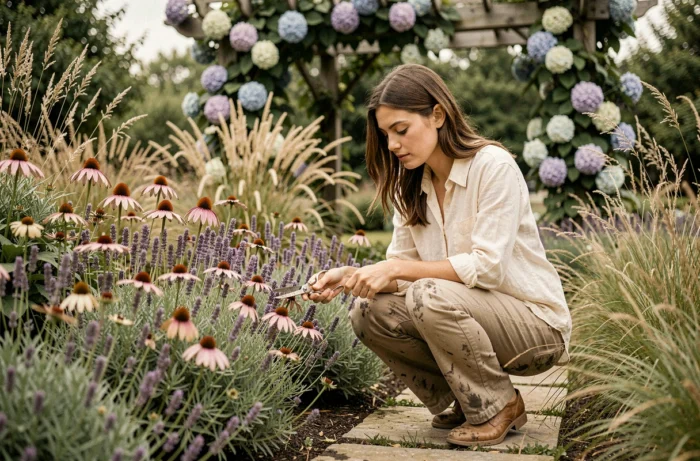
Maintaining Living Soil: Nourishing the Earth Rather Than the Plant
A common reflex is to add fertilizer when a plant shows signs of fatigue. But living soil, rich in microorganisms, nourishes plants continuously without constant intervention.
Homemade compost remains the most complete amendment for a garden. Vegetable peels, coffee grounds, crushed eggshells, and fine layers of grass clippings: the decomposition of these materials produces humus that improves both the structure and fertility of the soil. Spread a few centimeters thick on the surface in autumn or spring, it breaks down naturally without the need to turn it.
Avoid digging deeply. Turning the soil destroys microbial life and the networks of mycorrhizal fungi that help roots absorb nutrients. A simple superficial raking is enough to aerate the top layer before sowing or planting.
- Rotate crops in the vegetable garden to avoid depleting the soil of the same nutrients year after year.
- Sow green manures (phacelia, mustard, clover) on bare plots in autumn: they protect the soil from erosion and fix atmospheric nitrogen.
- Leave a corner of the garden partially fallow, with tall grasses and wildflowers, to encourage pollinators and beneficial garden insects.
A garden that transitions through the seasons without tiring is a garden where the soil works as much as the gardener. Choosing the right plants in the right place, mulching, composting, and harvesting rainwater form a foundation of practices that require little time once established. The rest is regular observation, season after season, which allows for adjustments and lets the garden find its own balance.