
You return your Italian coffee maker after serving, and a little water still flows from the lower chamber. This liquid residue is intriguing, sometimes worrying. The good news: this residual water in the Italian coffee maker is normal. It directly results from the design of the device and the physics of extraction. Understanding why it remains also helps identify cases where the amount becomes abnormal.
Residual water in the moka pot: the role of the riser tube
To grasp the phenomenon, look inside the lower reservoir. A small metal tube, called the riser tube or chimney, passes through the funnel filter and slightly extends above the bottom of the chamber.
This tube does not reach the floor of the reservoir. It stops a few millimeters above. All the water located below the lower end of the tube cannot physically rise to the upper compartment.
When the water heats up, the steam creates pressure in the chamber. This pressure pushes the liquid water through the tube, then through the coffee grounds, to finally end up in the upper part. The water below the level of the tube remains trapped in the base, as the pressure acts on the surface of the liquid, not below the tube itself.
This design detail is intentional. If the chamber were to empty completely, the aluminum or stainless steel bottom would heat up empty, which would damage the seal, the filter, and could alter the taste of the next coffee. You can also learn more on Goûts et Passions to delve deeper into this specific mechanism.

Safety valve and pressure: why the entire reservoir never empties
The safety valve, this small round flap visible on the side of the chamber, also plays a role in the volume of water that remains. It is calibrated to open if the internal pressure exceeds a threshold. Its location on the wall of the reservoir provides a visual reference: never fill water above the valve.
This reference exists because the valve needs an air space above the water level. This space allows steam to form and exert a steady pressure on the surface of the liquid. If the water covers the valve, two things happen: the safety can no longer release excess pressure, and the extraction becomes erratic.
Concrete result: between the water that cannot go down below the tube and the water that must not rise above the valve, the Italian coffee maker is designed to keep a little water after each extraction. This is not a defect; it’s a margin of operation.
When residual water increases: grind, limescale, and worn seal
Have you noticed that the volume of remaining water seems larger than before? Several factors modify the balance between pressure and extraction.
Grind too fine or too compacted
A very fine grind, close to that of an espresso, offers strong resistance to the passage of water. The pressure rises, but the water struggles to pass through the filter. A larger portion then remains in the chamber, and the coffee that arrives at the top comes out slowly, sometimes with a bitter taste.
The moka pot requires a medium grind, slightly coarser than for an espresso. Also, avoid compacting the coffee in the funnel filter: place the grind, level it with your finger, without pressing.
Limescale accumulated in the base
Limescale primarily deposits in the heated chamber, where the water stagnates after each preparation. Over the months, this mineral layer alters the bottom of the reservoir and can partially obstruct the base of the riser tube.
The residual water then gradually increases, extraction after extraction, without the change being visible to the naked eye. Regular descaling (hot water mixed with white vinegar or lemon, without coffee in the filter) allows you to restore normal operation.
- Rinse the chamber after each use to limit the deposits of fresh limescale on the metal.
- Descale the coffee maker every two to three months if your water is hard.
- Check that the base of the riser tube is not partially blocked by a whitish deposit.
Worn or misaligned sealing ring
The silicone or rubber seal, located between the chamber and the upper part, ensures the tightness of the whole. When it hardens or deforms, steam escapes through the threading instead of pushing the water upwards.
A steam leak at the seal reduces the useful pressure and leaves more water in the reservoir. If you see steam escaping around the edge of the coffee maker during heating, the seal needs to be replaced.
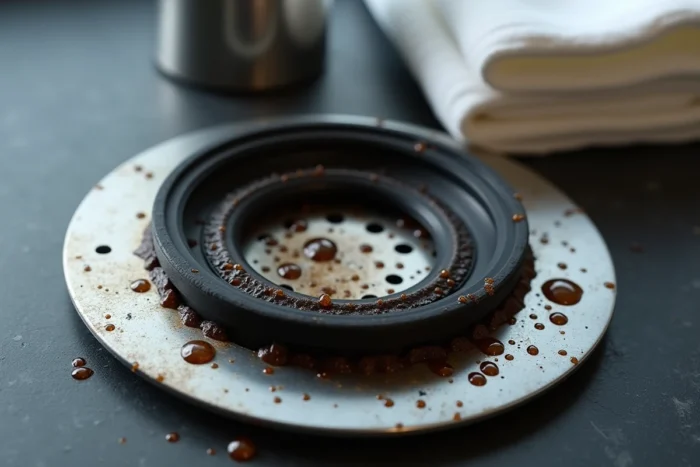
Italian coffee maker on induction cooktop: a special case
Induction-compatible models have a stainless steel chamber (sometimes with a magnetic bottom). The thermal conductivity of stainless steel differs from that of aluminum: the heating is more localized and sometimes faster.
On an induction cooktop set too high, the water boils violently. Excess steam forms, the valve may whistle, and the extraction occurs irregularly. The coffee rises quickly, but an abnormally high amount of water remains at the bottom.
- Set the cooktop to medium power to allow the pressure to build gradually.
- Remove the coffee maker from the heat as soon as the coffee starts to gurgle in the upper chamber.
- Check that the diameter of the coffee maker matches the heating zone of your cooktop, as a mismatch disrupts heat distribution.
On a gas stove, the problem is less frequent because the flame envelops the base more uniformly. The pressure build-up remains more gradual, which leaves less residual water.
A little water in your Italian coffee maker after extraction is nothing to worry about. It is a sign that the valve, the tube, and the seal are functioning properly. The warning sign is the opposite: if the volume of residual water changes significantly from week to week, inspect the seal, check for limescale buildup, and adjust your grind. The consistency of this little bit of water is the best indicator of a moka pot in good condition.